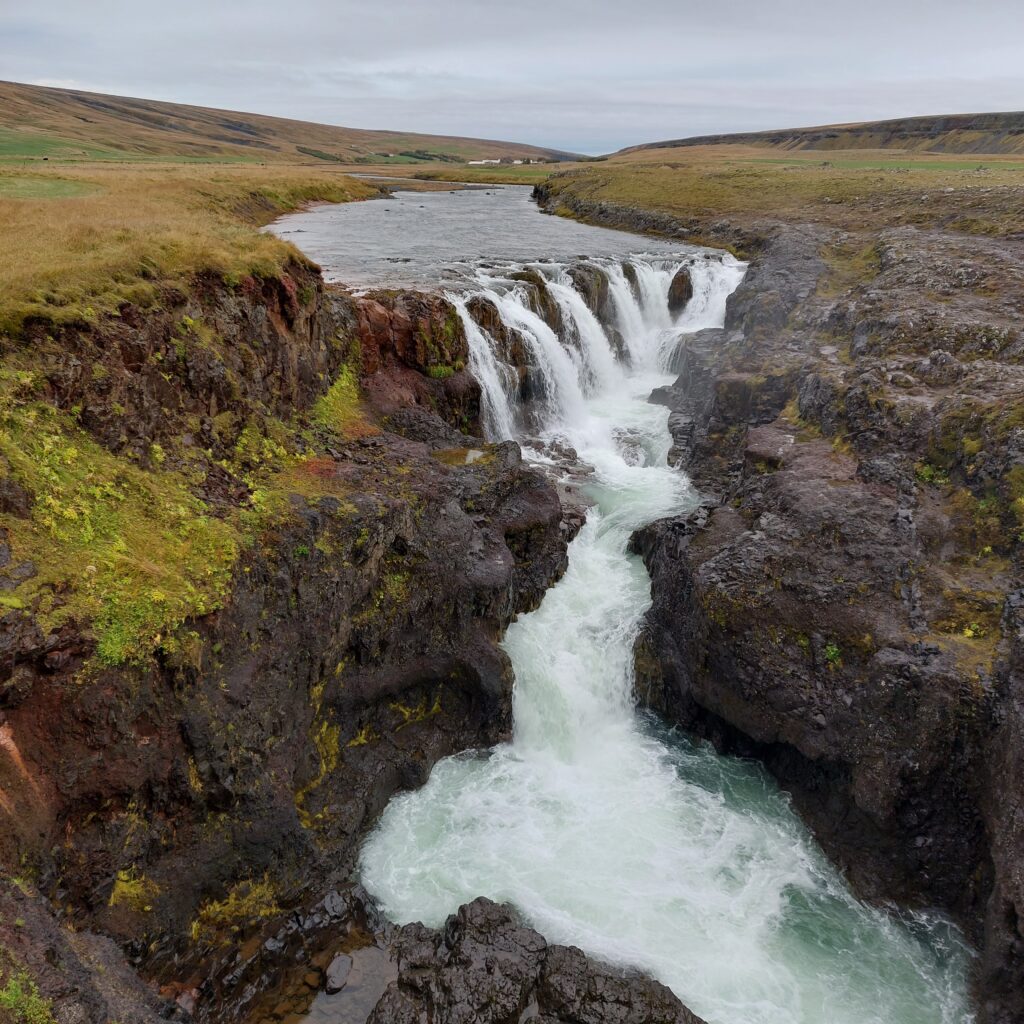
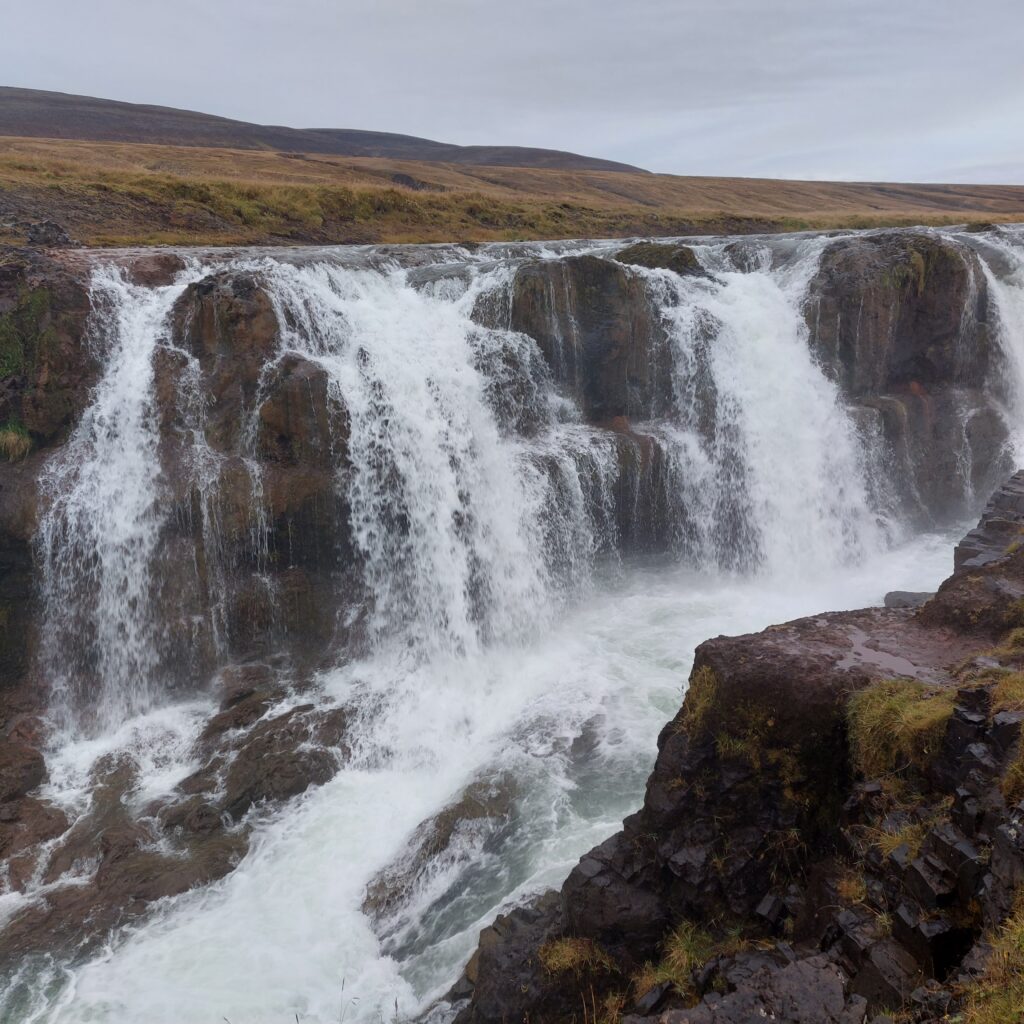
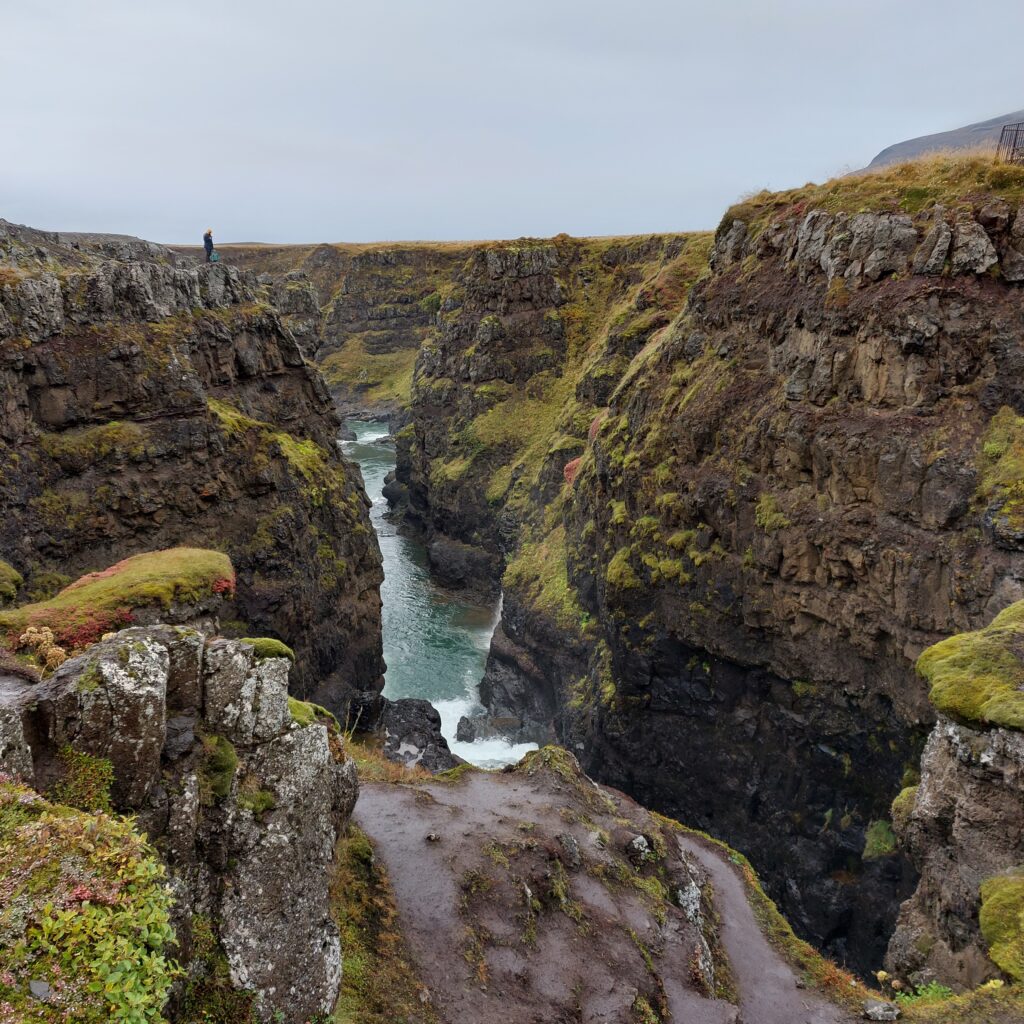
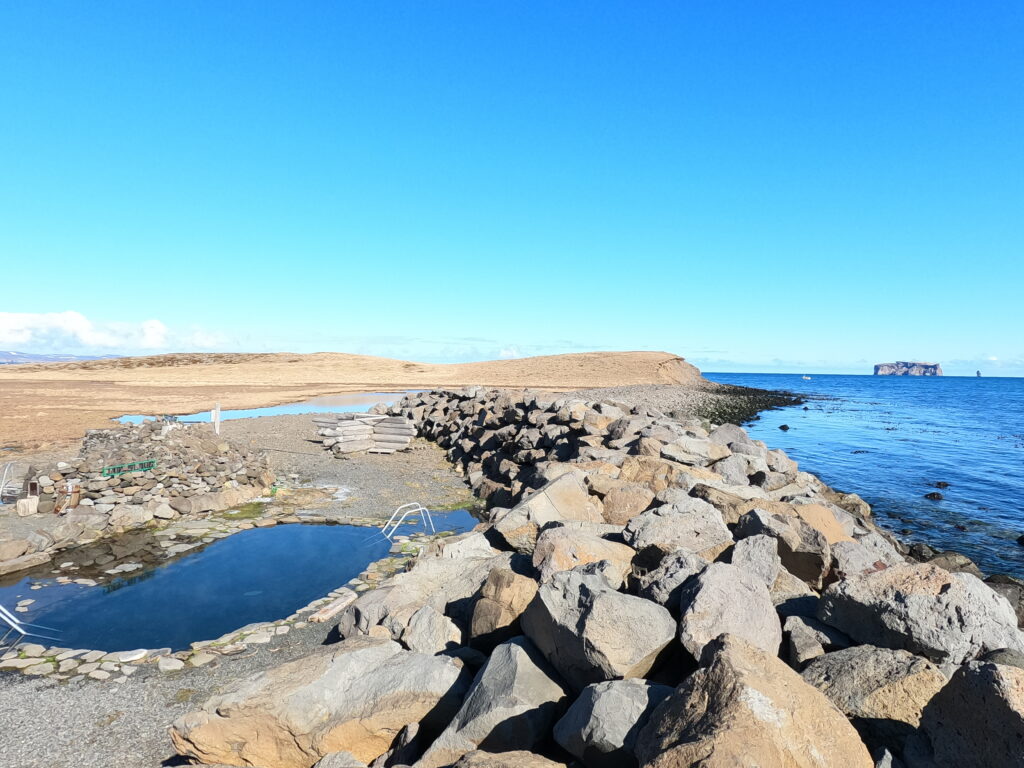
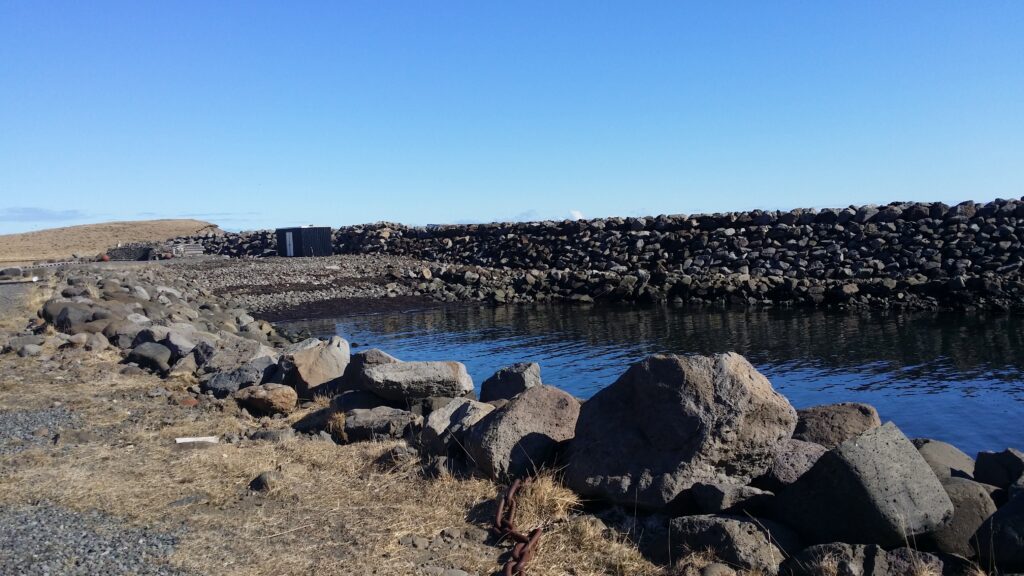
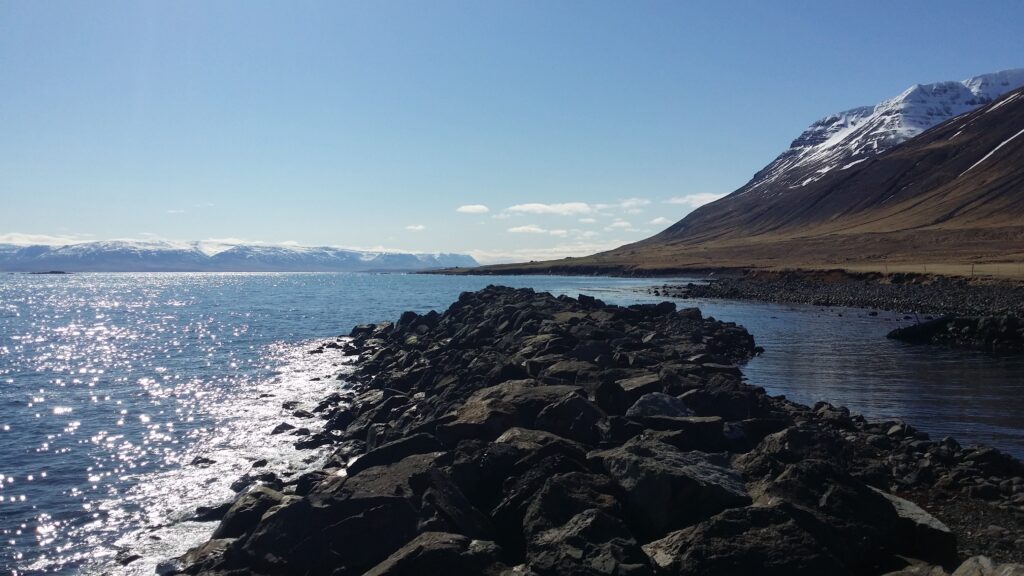
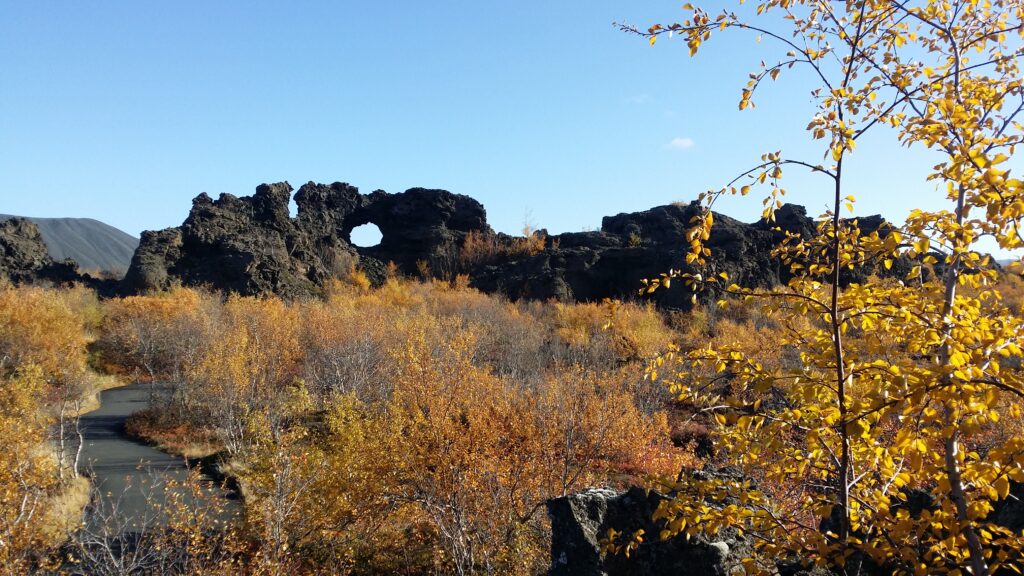
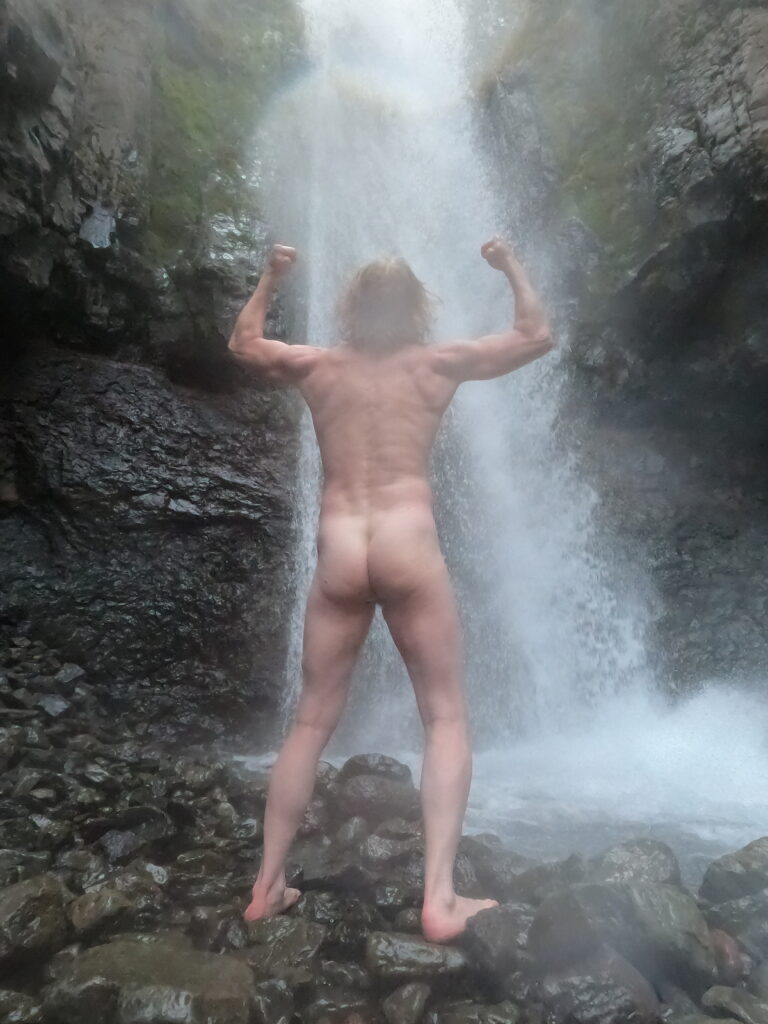
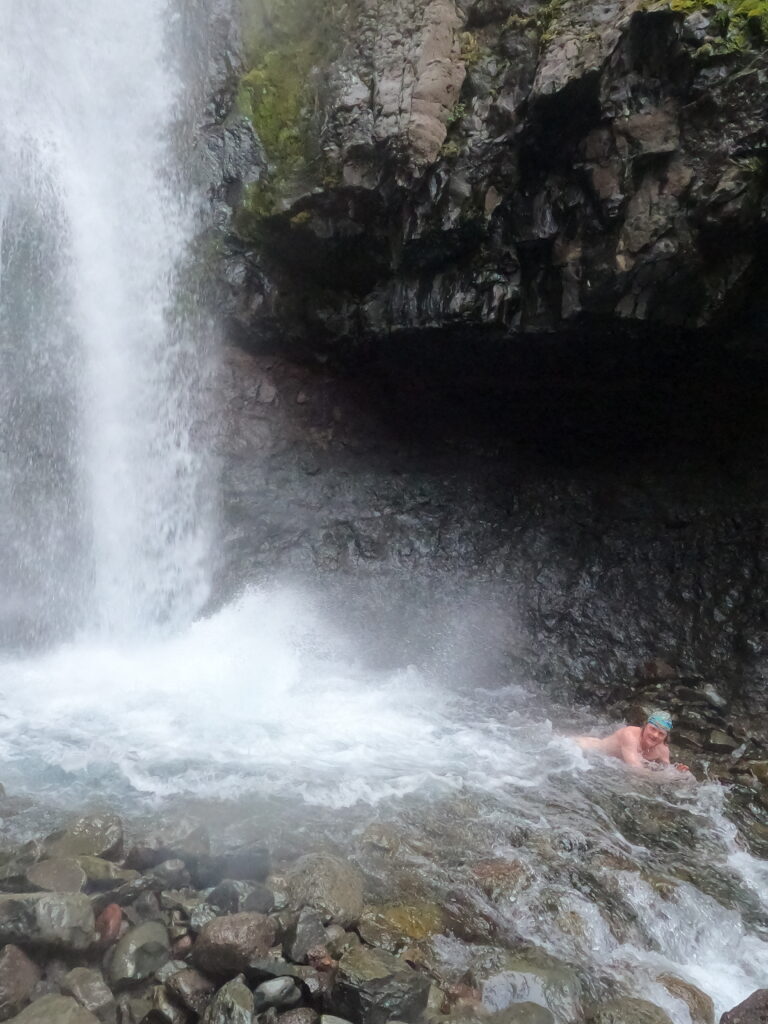
South of Hunafjörður, the river Víðidalsá has excavated a gorge, which might be an exciting bathing place, Tobatheornottobathe thought. A gill! That’s interesting!
Kolugljúfur is 1 km long and 40-50 meters deep.
Error upon error – it wasn’t suitable to swim here at all, the gil was far too dangerous, and it also turned out that the gully wasn’t dug out of the river, it was the troll woman Kola who did it!
A quite stylish gorge, indeed!
Tradition says that Kola lived in the ravine, had her bed there and lived off the salmon she caught in the river. She ate the fish raw, or she cooked it in the gil. This is a splendid place to visit, but you don’t need a swimsuit here.
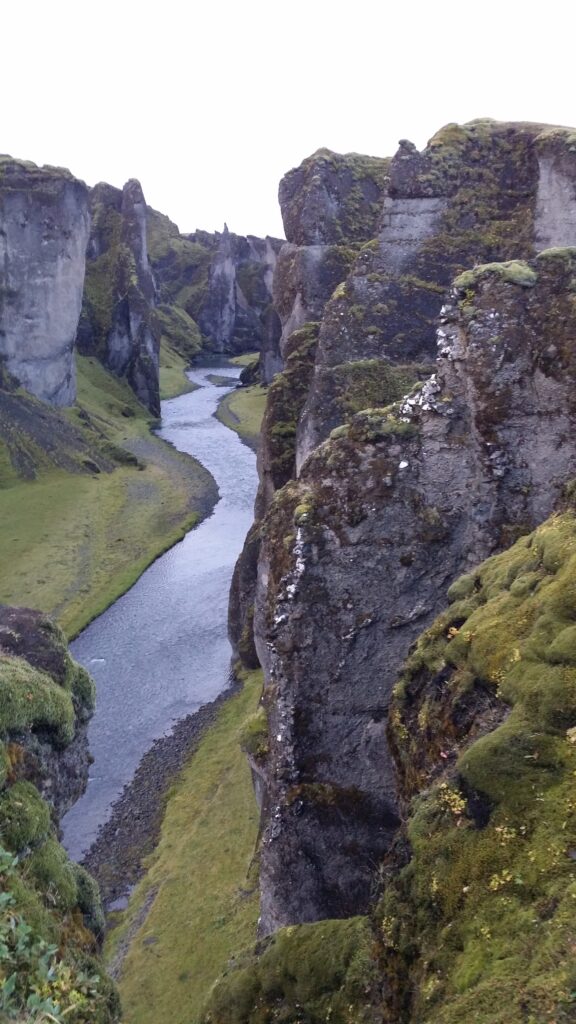
Iceland has many rivers, caused partly by a steady humid climate, but also because many of them come from glaciers. The color of the rivers varies greatly, from clear or whitish-gray to blue or green.
The purple river. Fjaðrárgljúfur, Suðurland.
The rivers are colored in many ways, for example by algae, particles or air bubbles. The importance of the rivers in Iceland is made concrete by the fact that each one of them is marked with their name by the road (not all churches are granted such an honor!).
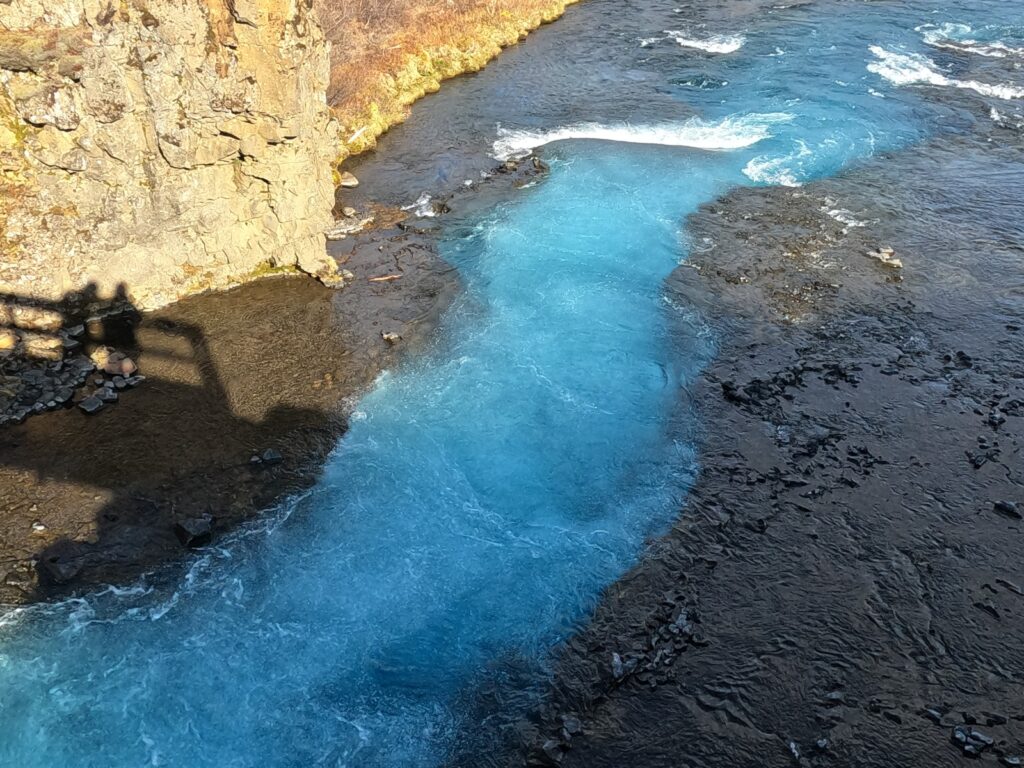
Brúará. The blue river used to be crossed by a lava bridge (bridge = brú).
In Iceland they use the word á for river (pronounced as the diphthong ao), as in the Norwegian word ‘å‘. The longest Icelandic river is Þjórsá (The Bull river). It flows south from the Hofsjökull glacier, is 237 km long and has a catchment area of 8,000 km2. From the Book of Settlements (Landnámabók): ‘There was a man named Torarin who was the son of Torkjell from Alver (West Norway). He came with his ship into river Þjórsá’s estuary. He had a bull’s head in the prow, and after this the river got its name.‘
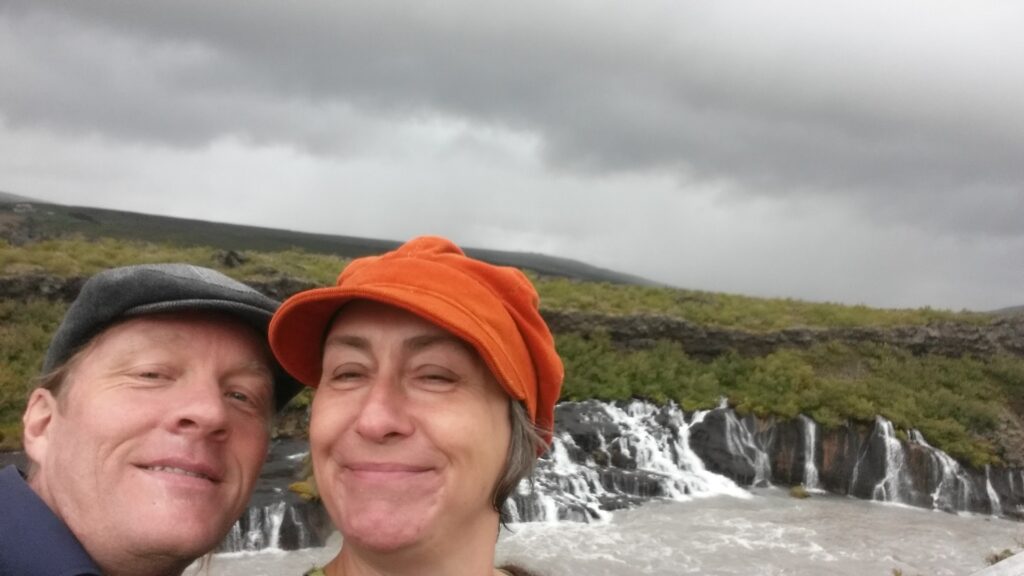
Hraunfossar falls into Hvitá.
When it comes to swimming, rivers are not so easy. Either they are too shallow, too muddy, the riverbank can be uncertain, the current is too strong, or it is simply too steep.
No, the riverbank itself is not steep. But how do you get there? Jökulsá á Brú.
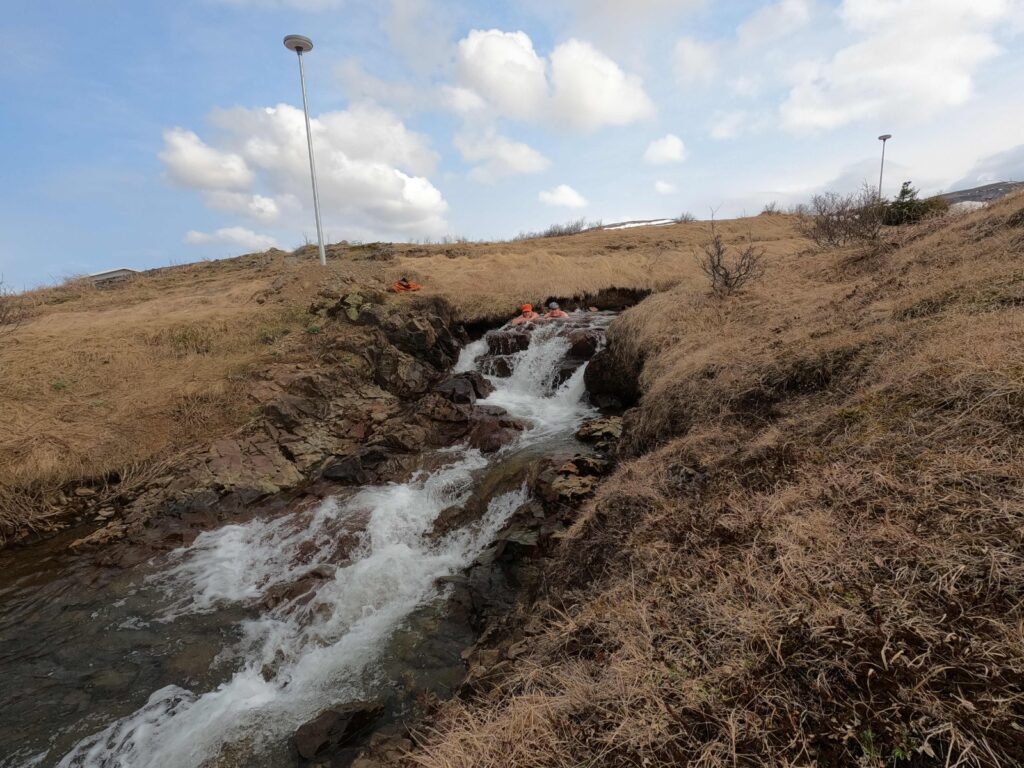
There are therefore very, very, very many Icelandic rivers that we have not bathed in. When we stayed overnight in Hvammstangi, just above the church, we immediately saw that there was a path along the river, and a morning bath was put on the program. Yes! A dip in Hvammsá before breakfast was just right. So refreshing! So simple! And no. It was not a river, it was a stream. It should have been called Hvammslækur (The Hvamm Stream)!
Happy morning bathers in Hvammsá.
Then Knut discovered that there were several pools that could be used for bathing. As said, so done.
Oh yes, you will always find seals at Hvammstangi.
Seals were an important resource in Icelandic society back in the old days. Both meat, skin and fat were valuable, and a seal head dinner was a completely normal diet on the coast (might be about the same as eating sheep head or ‘smalahove’ in Norway?). Salted and cooked seal meat was the common method of preparation, which Idun’s brother Frode has distributed via a Norwegian recipe for seal flippers from Northern Norway (Troms). For a population that was occasionally starving, it was important to utilize the entire animal. Although seal hunting has declined significantly, pickled seal flippers are still prepared in many Icelandic homes. The sour taste comes from the technique of boiling them first, and then put them in whey. (ref Karitas, by Kristínu Marju Baldursdóttur, or the books of Halldór Laxness, or Bergsveinn Birgisson).
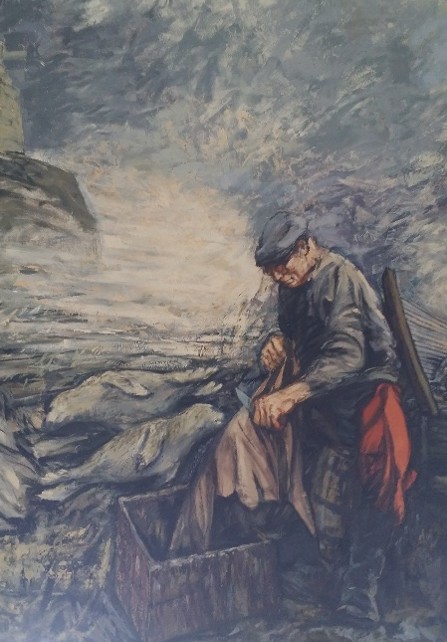
Skinning of seals. Ceiling painting, Flateyjarkirkja.
Today, the hunting of these animals is limited, due to some concern about declining populations. Seal skins from Iceland are no longer processed. All Icelandic tanneries have closed down after Chinese tanneries secured a monopoly by buying up all the skins for several years.
Swimming with seals, Strandakirkja. Maybe not that impressive, but the two dots behind Knut are actually seals.
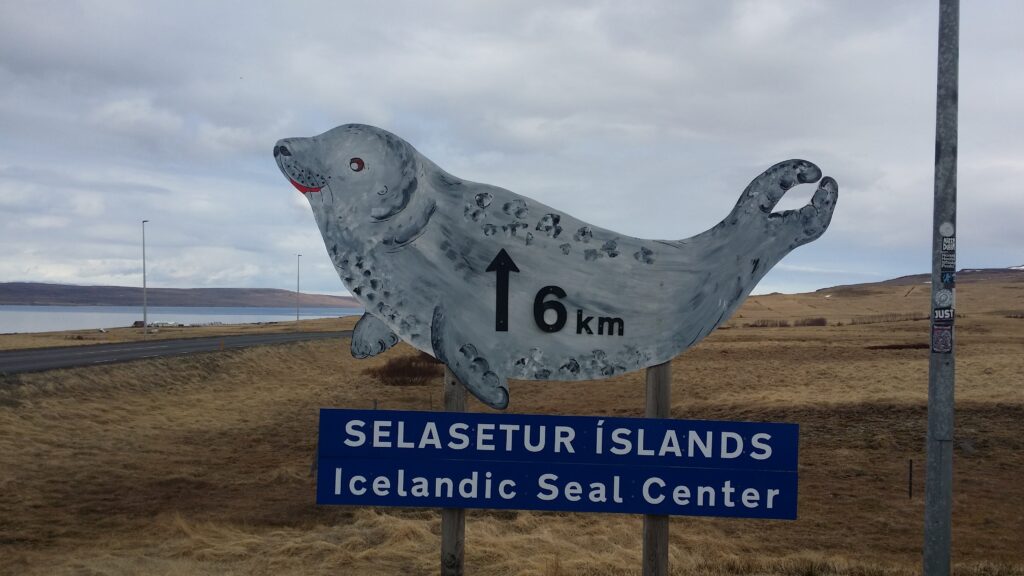
We have been to ‘County Seal’ twice.
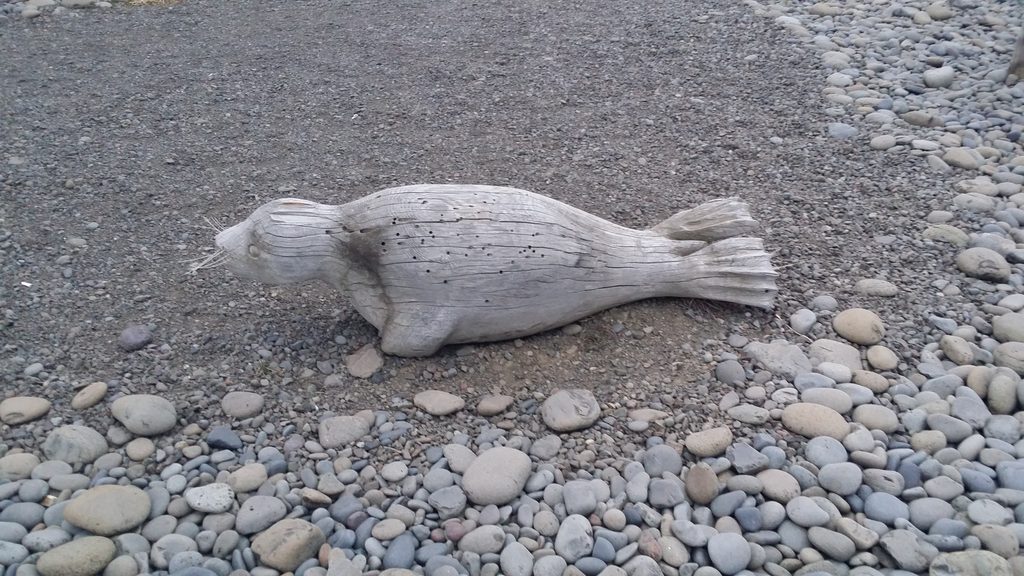
‘I want to visit County Seal!‘. But what about the seal itself?
At Illugastaðir, paths have been created by the sea so that visitors can observe seals.
From Restaurant Sjávarborg. Some people like fish more than others. But for us, cuddling with seals was not an option…
On the floor above the seal museum you will find Sjávarborg, a really good restaurant with a very acceptable view.
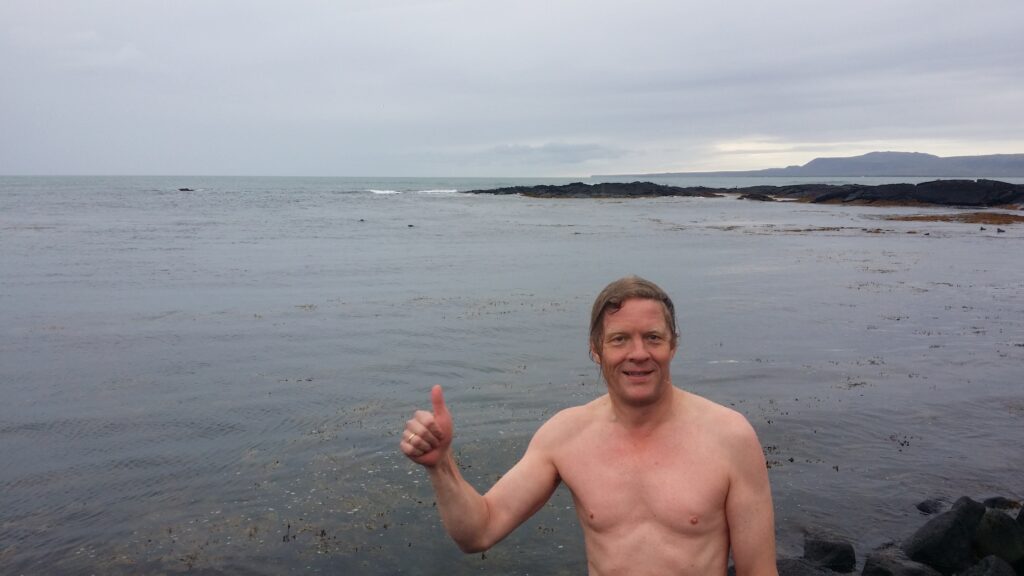
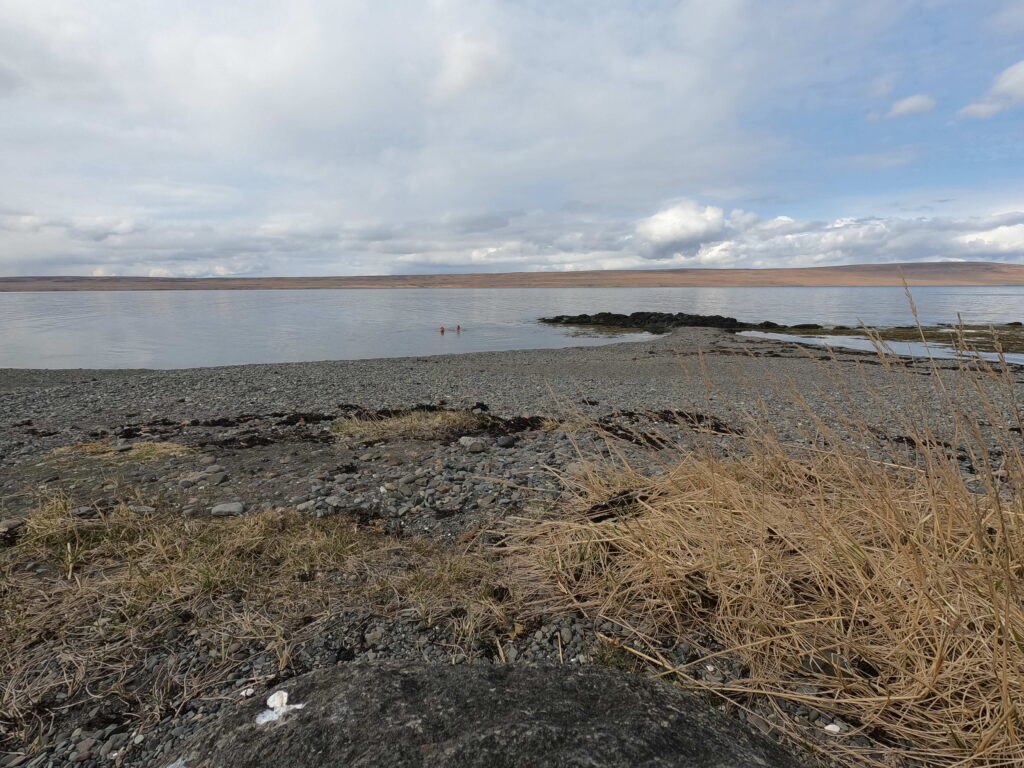
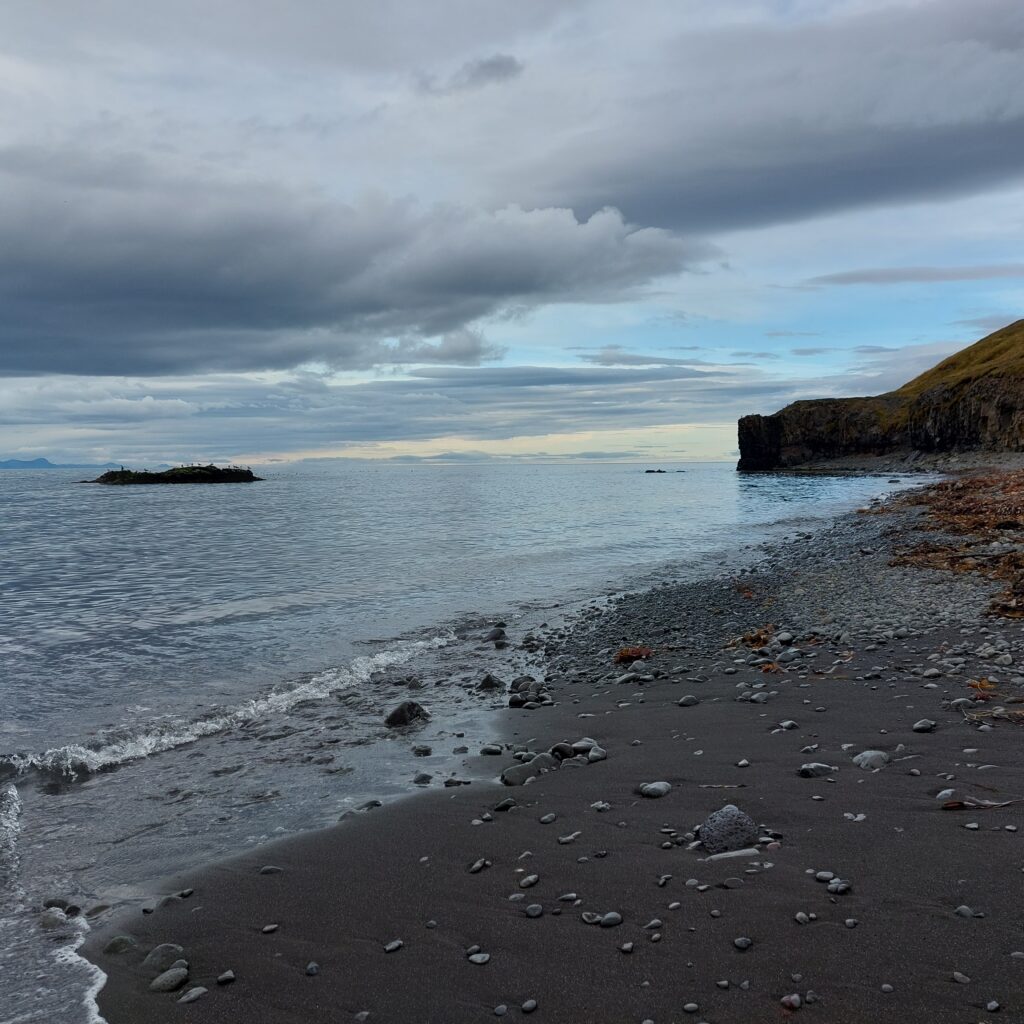
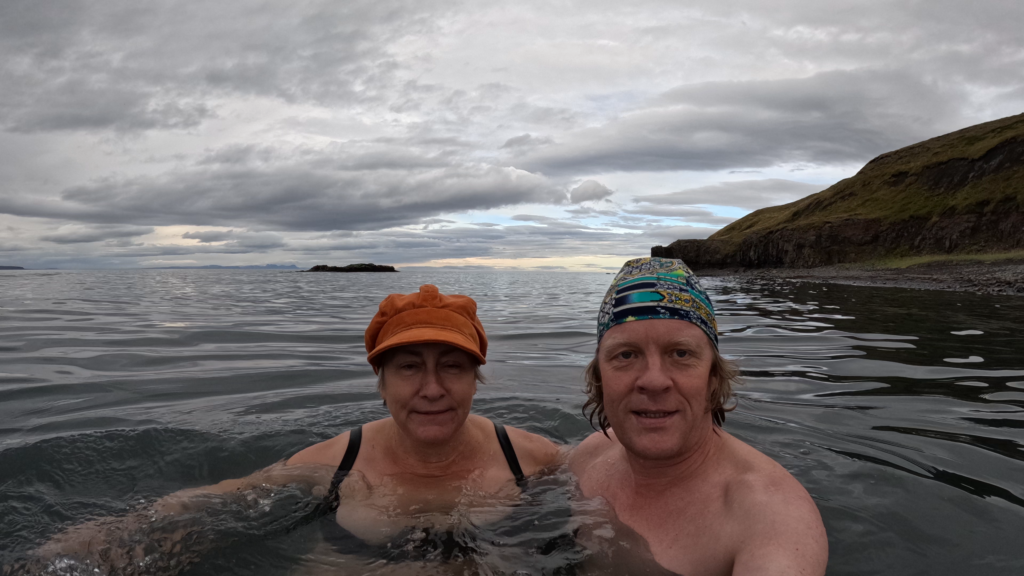
We swam on the innermost beach in crystal clear water, with a flock of slightly disgruntled eiders swimming outside. Fresh and beautiful sea with a pink sunrise over the white mountains to the north.
Húnafjörður in northwest Iceland is a 10 km wide and 15 km long fjord arm, the eastern part of the larger bay/fjord Húnaflói. The name should mean the same as the Norwegian place name for ‘Hun’ (either dog or female animal), one might think, but no, the name comes from Húna, which means bear cub. What kind of bear was this then, one might wonder, there were no other mammals in Iceland when the Vikings came but the polar fox. Well, AI claims that it was a man named Húni (Bear) who gave the fjord its name – without being mentioned in the Book of Settlements. Mysterious! Anyone know?
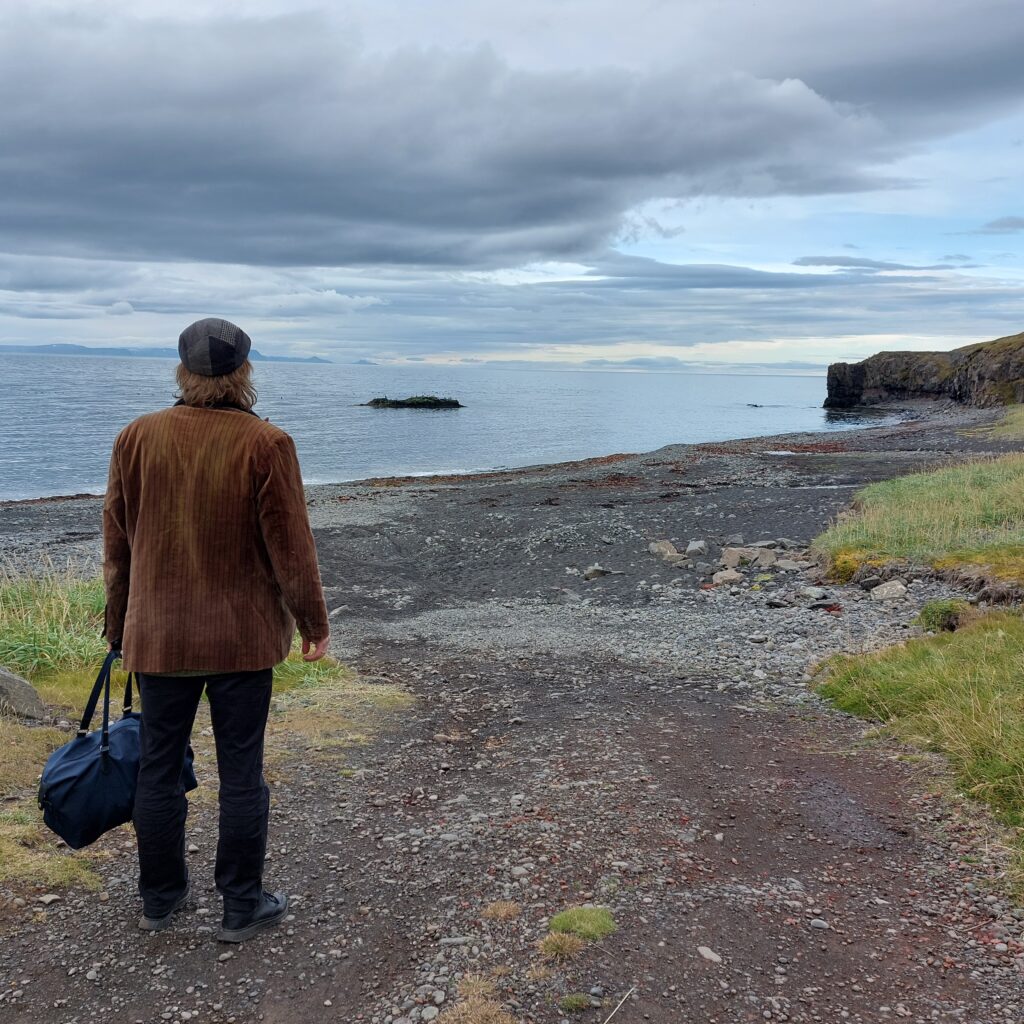
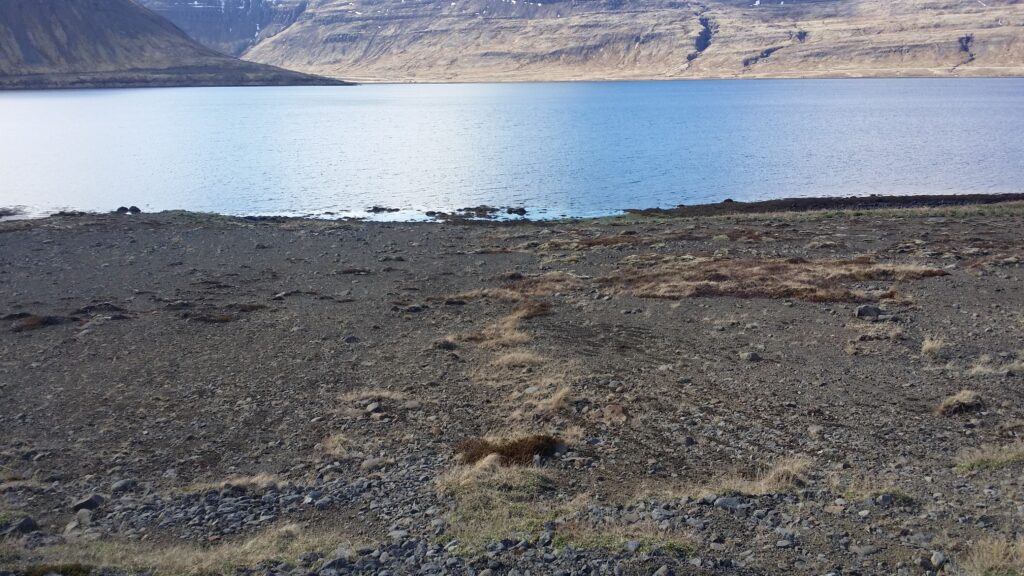
Húnafjörður. Our bathing beach.
However, one who is mentioned both in the Book of Settlements and in connection with bears – of the polar bear type (!) is Ingemund, who landed in Vatndalur, east of Húnafjörður.
‘Ingemund was a great Viking, and constantly ravaged the West Vikings. He had a friend from the Sudrøyen, his name was Sæmund. They came from a military expedition at the time when King Harald went ashore and prepared for battle in Hafrsfjord…. Ingemund had difficulty settling down anywhere, and therefore King Harald thought that he should seek his fortune in Iceland… So Ingemund begins his journey to Iceland… Ingemund found a polar bear mother with two cubs at Húnavatn. Later he went out to Norway, and gave the animals to King Harald, and no people in Norway had seen polar bears before. Then King Harald gave Ingemund a ship with timber, and Ingemund went with his two ships to Iceland, as the first man to sail northwest of Skage.’
Vatnsdalur lies south of Húnafjörður.
Polar bears roam from East Greenland to Iceland at irregular intervals. In total, there have been about 600 sightings from the time of the Settlement to the present day, i.e. about one polar bear every two years. The highest number was 73 in 1881! However, the last polar bear visit was at Hvalsnes in 2016, and it is assumed that the number of polar bear visits is decreasing due to climate change, as they will drift across the Denmark Strait on the fjord ice less often.
Knut is looking forward to a cold swim in Húnafjörður.
On the east side of Húnafjörður, just off Ringvei 1, lies the village of Blönduos, where the river Blöndu meets the sea. It is a nice place to spend the night, and Badebadebade thought that a place with a river and an estuary must offer exciting swimming opportunities. However, the receptionist was very skeptical about swimming in the river, he preferred the fjord. As said, so done, we went to the beach instead. It was a bit messy on the road, but the beach itself was a little gem, so we ignored that (old car tires and various debris and garbage).
Luckily unknowing we were not swimming alone!
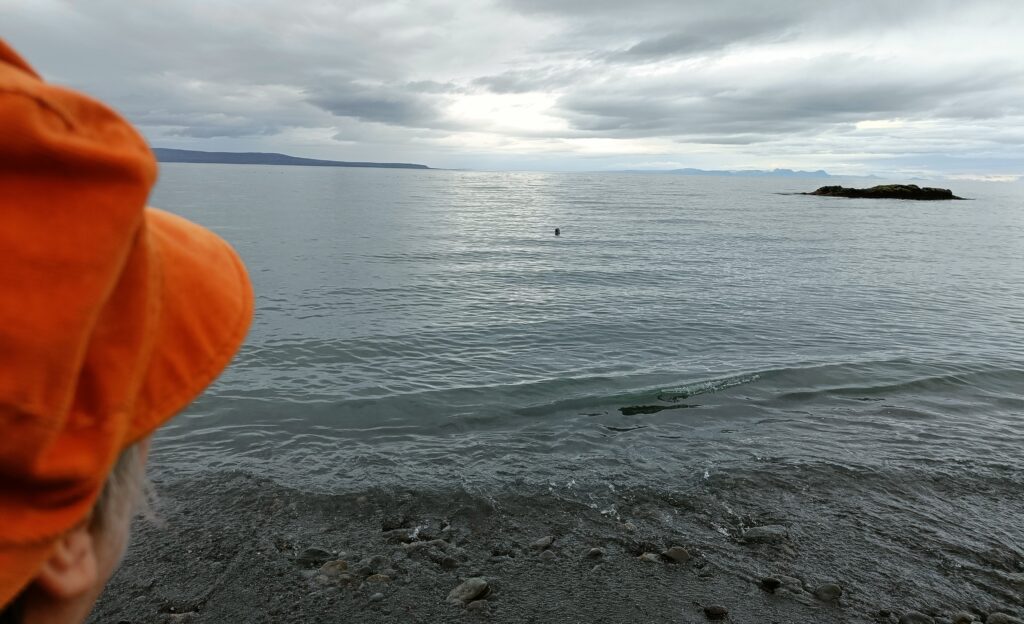
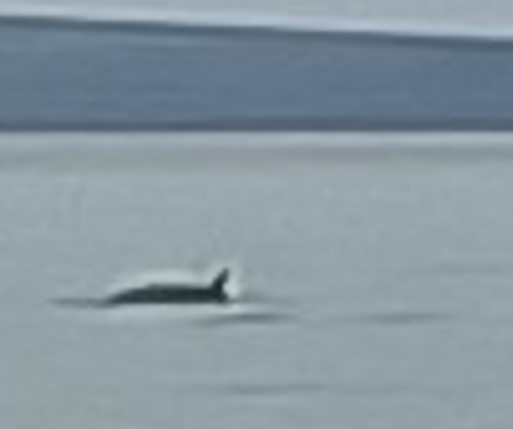
While we were getting dressed after the swim, we suddenly saw life in the water. There was no less than one whale and 2 seals who wanted to say hello! What a surprise! Unfortunately, we didn’t have any zoom lense for the cameras.
Zoom in a little and you see the seal in the middle of the picture, looking at us!Zoom in even more and you see the whale in the middle here!Here it is!
In the heart of Húnafjörður, on the opposite side of Blönduos, there is an interesting cliff below the shore: Hvítserkur. This great sea stack stands in the floodplain and looks like a large animal.
Big fjord, small cliff.
In good Icelandic tradition, this figure is of course a petrified troll. The story goes that this troll ravaged the north of Iceland in ancient times, and as trolls have said before (ref. Norwegian folk tales): This smells like Christian blood! There are no trolls who enjoy Christianity. The troll had grown tired of the constant ringing of the bells in Þingeyraklausturskirkja church, and decided to tear them down one night. But the troll miscalculated the time, and turned to stone when the first rays of the morning sun hit it.
Knut is looking forward to meeting Hvítserkur up close. View southeast towards the fjord bottom of Húnafjörður.
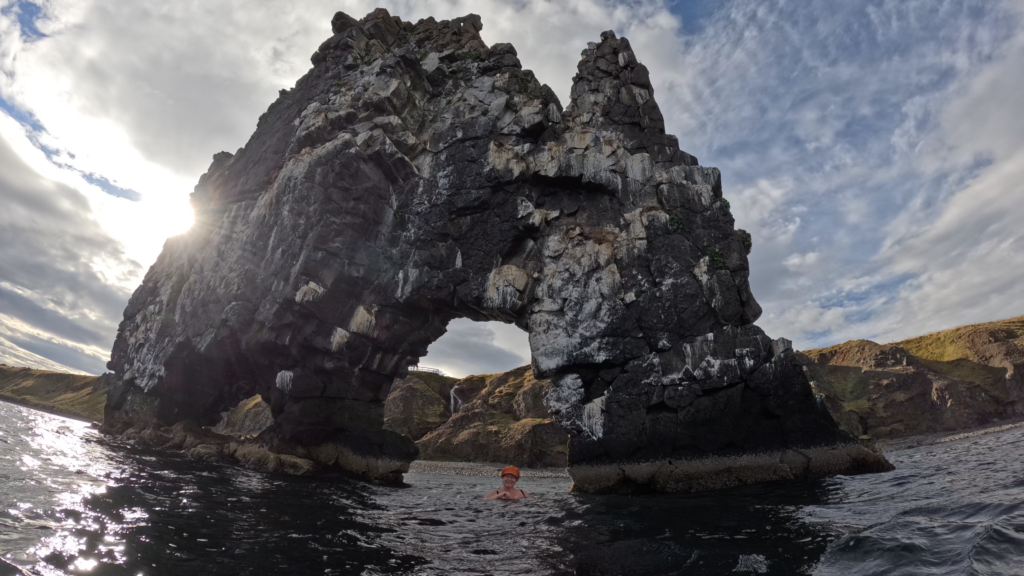
Tobatheornottobathe wanted to swim under Hvítserkur! We had watched the cliff several times from a distance, and learned that swimming under it is only possible at high tide – Hvítserkur is landlocked at low sea. A little planning may therefore be advisable.
The ‘Rhino’ cliff is also beautiful when viewed from the visitor platform.
Hvítserkur is made of basalt. It was once a plug in a volcano and has therefore been more resistant than the volcano around it. Over the years, birds have dropped their droppings on top of the black basalt, and it is guano that gives the white color and the origin of the name. Ironically, Lutheran priests often wear white robes, and in this sense one could almost say that Christians have converted the troll? The cliff is a favorite nesting site, and there are a lot of birds on and around Hvítserkur, so much so that it almost looks alive.
The walk to Hvítserkur is neither long nor demanding. If it looks steep, just follow the path further inland towards the fjord bottom before going down to the shore and back again.
When you visit Hvítserkur you are not alone! Maybe it would be just as good to get help with the photography? There were many photographers with various special equipment present when we were there. It is not true, as some travel agencies claim, that Hvítserkur is a hidden gem. It is very well known, with well-established access/parking/viewing platform.
And the swimming? Great to swim under the cliff! It’s a short swim, easy for most people.
Wave erosion has dug out the animal’s legs, and to prevent further washing out, reinforcements have been cast into the bottom. However, this was done so discreetly that we actually didn’t see any concrete foundation when we swam underneath. We say like the Icelanders: ‘All good!’
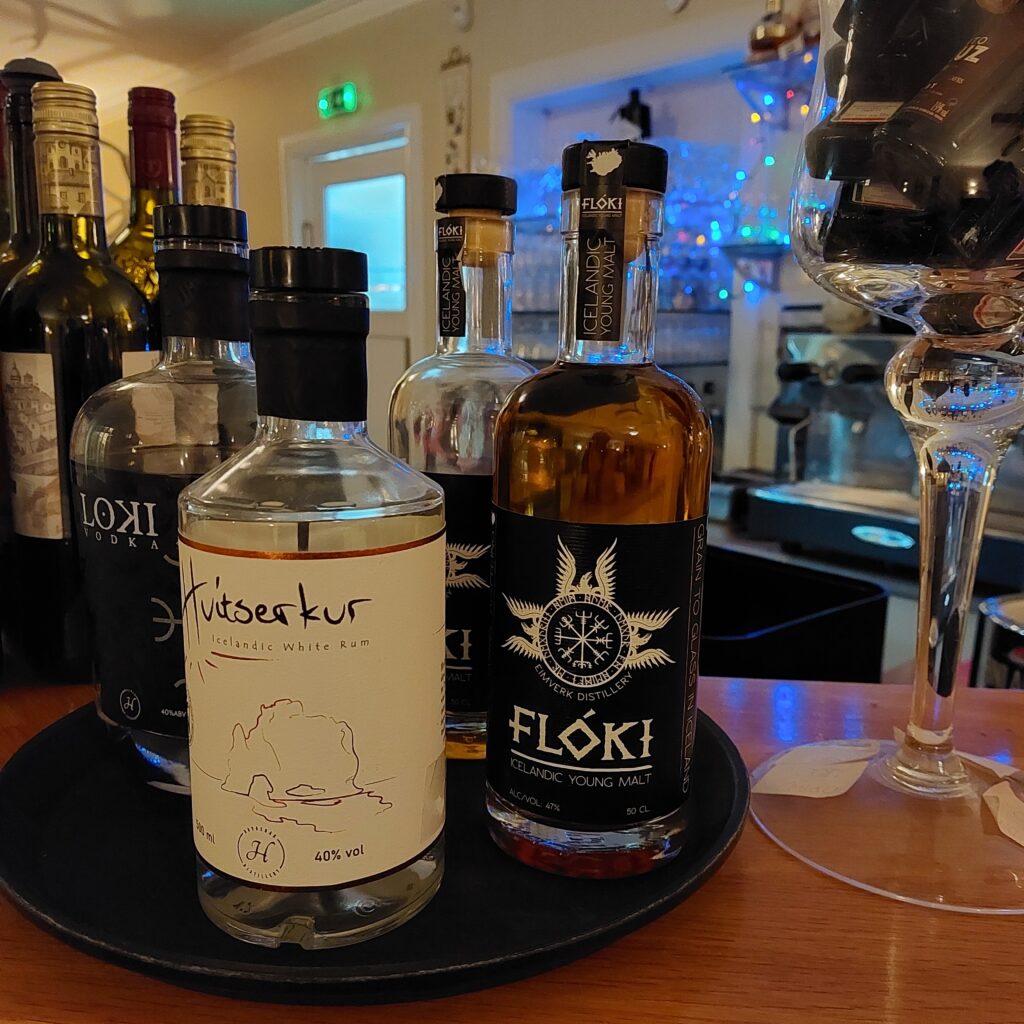
After a swim under or around Hvítserkur, a ‘small, strong one’ might be a good idea!
The fermentation of Hvítserkur rum takes place in the Caribbean, with molasses from Jamaica. The distillation takes place at Hovdenak Distillery in Hafnarfjörður, with subsequent aging in sherry casks. Enjoy!
A hardhouse who got his own saga is Grettir the Strong Ásmundarson, who lived around the year 1030. Grettir and his saga are very popular in Iceland. He was constantly in battles and killed several men both in Norway and Iceland, and he accidentally caused arson in Norway – to name just some of it. As a child he abused and killed animals, and his first homicide was at the age of 14. The saga describes battles against trolls, ghosts, goblins, berserkers and ordinary people. Grettir is described as combative, fierce, brave, and very strong, which is a potent combination. During a battle against the ghost Glám (which he actually defeated), he had a curse cast upon him: Grettir would be pursued by misfortunes, an outcast and afraid of the dark. Nevertheless, Grettir managed to survive 19 years as an outlaw, even though a good price was placed on his head and many expeditions were sent out to kill him. At the same time, there were also many people who helped him.
The strait between Drangey and Reykjadiskur is called Grettissund. According to Wikipedia, no one has swum across the strait since 1030. Start exercising, guys!
The outlaws were a nuisance in the area, who had to steal to survive. Sheep disappeared and all travelers risked being attacked when passing through their territory. After 16 years as an outlaw, Grettir had drawn what was left of goodwill from notables in various districts throughout Iceland, and he then accepted the advice to move out to the rocky island of Drangey at the far end of Skagafjörður in Northwestern Iceland.
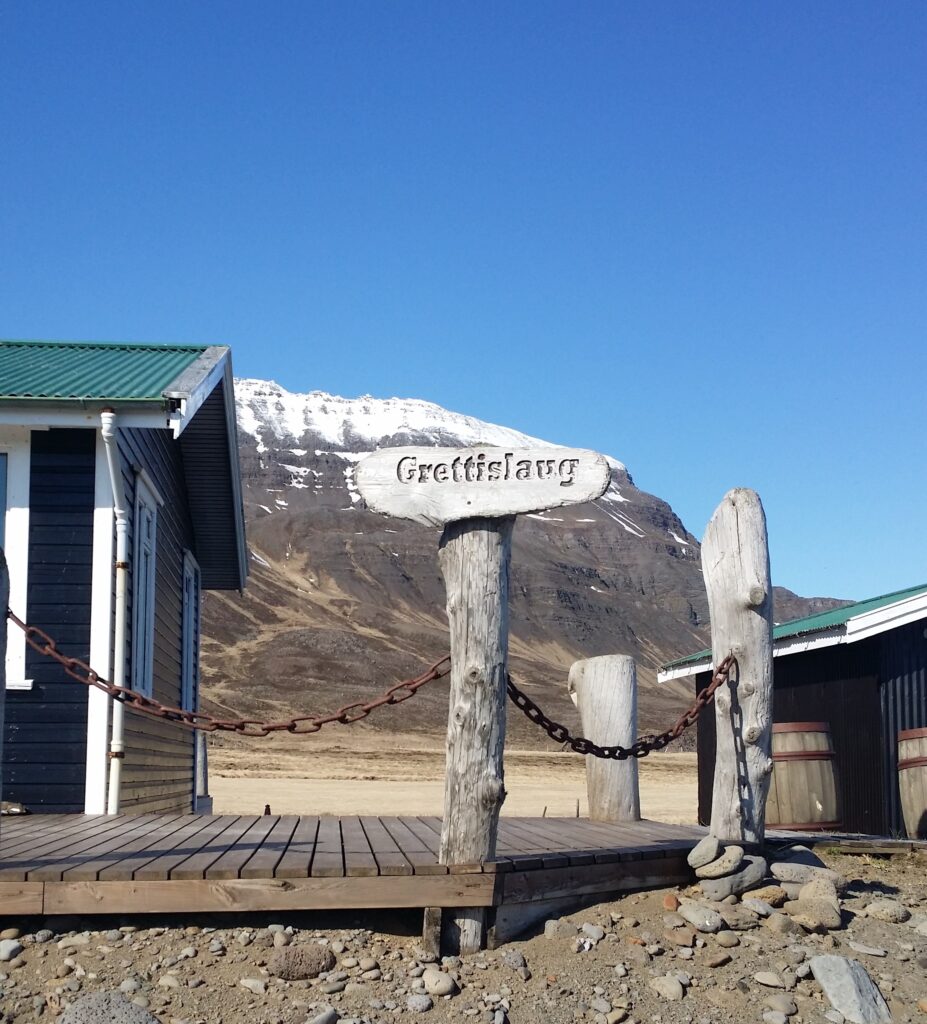
Grettislaug. As tough as its namesake?
With him he had Illuge, his brother, and a slave, Glaumir – Grettir had become afraid of being alone. There they lived on birds, fish and the villagers’ sheep. The plateau at the top could not be reached without the ladder that hung there. Grettir only had to pull up the ladder and he was safe (who had climbed up in the first place and made the rope ladder is not mentioned in the saga…). One winter day the fire in the hut went out, and Grettir had to swim ashore for fire. The swim was a struggle, it is 7 km from Drangey to land! Fortunately he was able to warm up again in Reykjaströnd, where there is a hot spring. As the saga puts it: ‘He baked for a long time in the bath, for he had become cold from the swim‘.
Deeply charming, rough and tough to Badebadebade’s taste.
Then it was just a matter of swimming back with the fire. The Vikings had a separate chamber in their fireplace, for storing fire at night. It was obviously time-consuming to make a new fire. Such a fireplace was found in the Norse settlement at L’Anse of Meadows in Canada (This may have been Guðriður’s fireplace, as a handrail for spinning wool was also found at the same site). Ref the bath ‘Leifur Heppni Eiríksson’).
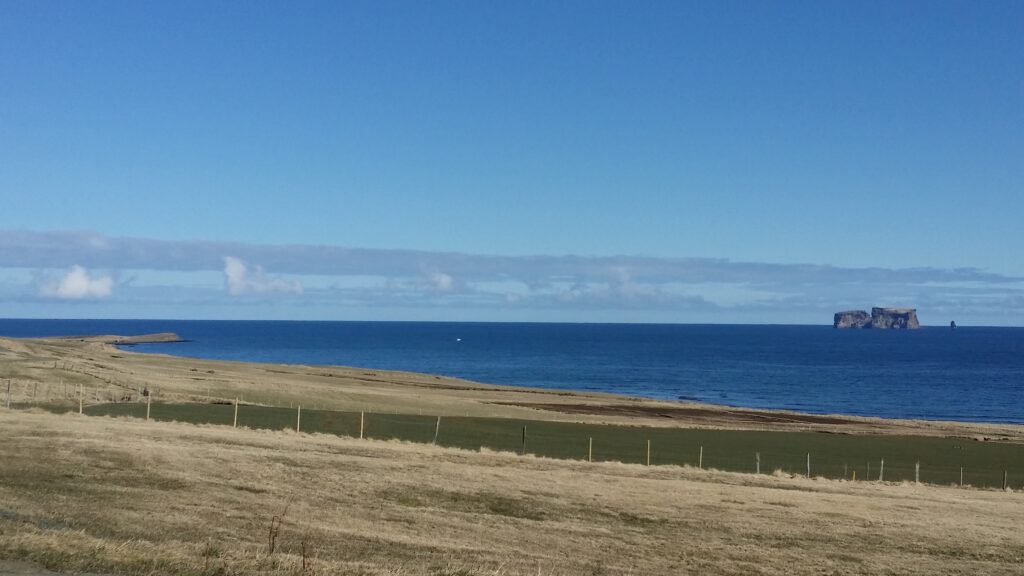
Grettislaug with Drangey in the background. A myth tells about to trolls who brought a cow over Skagafjörður. They turned to stone and Drangey is the cow, while the troll wife is the cliff beside it. The troll man’s cliff fell in an earth quake in 1755.
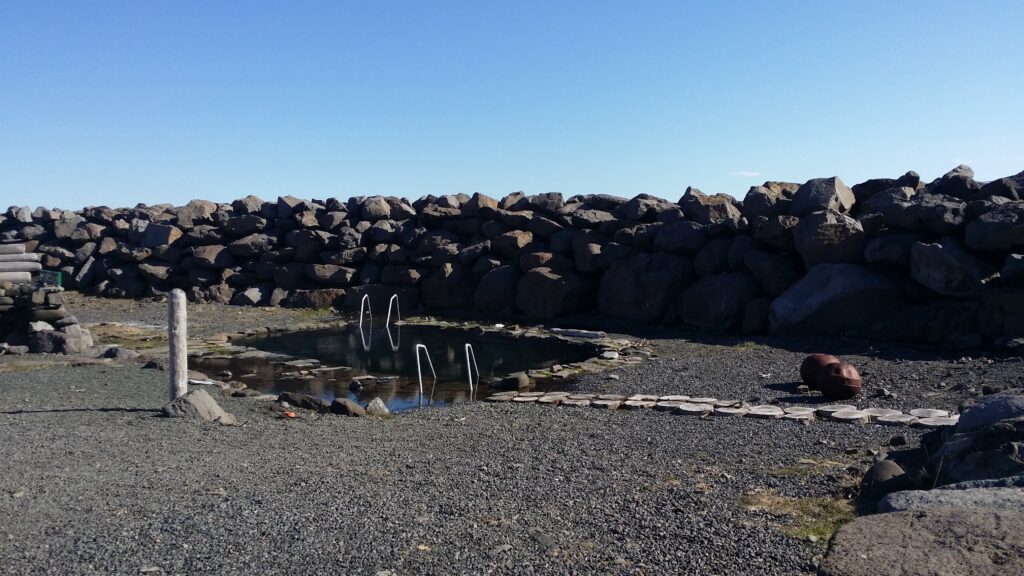
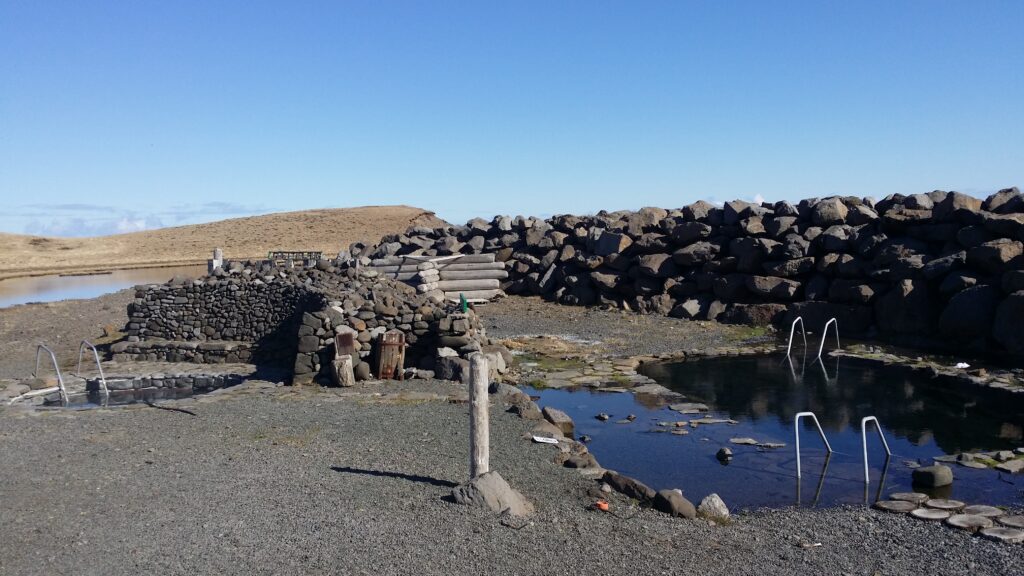
Originally there were two pools here. One was called Reykjalaug and was used for washing, while the other is described as a mud puddle. The pools were destroyed in a storm in 1934, after which the spring water came up into the fjord. Farmer Jón Eiríksson Drangeyjarl restored the bath in 1992. The bath is protected by a rampart, so unfortunately you cannot see Drangey from the bath.
Check if the baths are open if you want to go there. Actually, physically they are always open, the question is if you are allowed to use them (signs will tell you). This is private property, so taking a bath when it says you’re not allowed would not be very respectful. Tobatheornottobathe actually respects that kind of regulations and has been there twice without bathing. Did we take a bath the third time? That is the topic of an internal debate, memory is a difficult thing. But since there are no pictures, it can’t have happened?
At Grettislaug, it’s a short way to a cold dip in Skagafjørdur.
The bath is now called Grettislaug and consists of two stone-lined hot pools, with a small black beach next to it for cold swimming. Highly recommended!
Bring cash to this bath, in case there is no one else there, they ask for a small contribution to keep everything nice. We have visited Grettislaug several times. One late autumn evening in rain and storm, Knut got to help drive sheep into a truck. This is what happens when you drive on narrow, bumpy country roads in Iceland.
If you look away from the protective rampart, there is a fantastic view from Reykjadiskur.
The birch forest returns to Dimmuborgir. What will the view be like then?
‘What should you do if you’re lost in the forest in Iceland? Stand up!’
The natural forests in Iceland are scrub forests consisting of junipers, willows and low birch. However, when the Vikings arrived, much of the country was covered in proper forest.
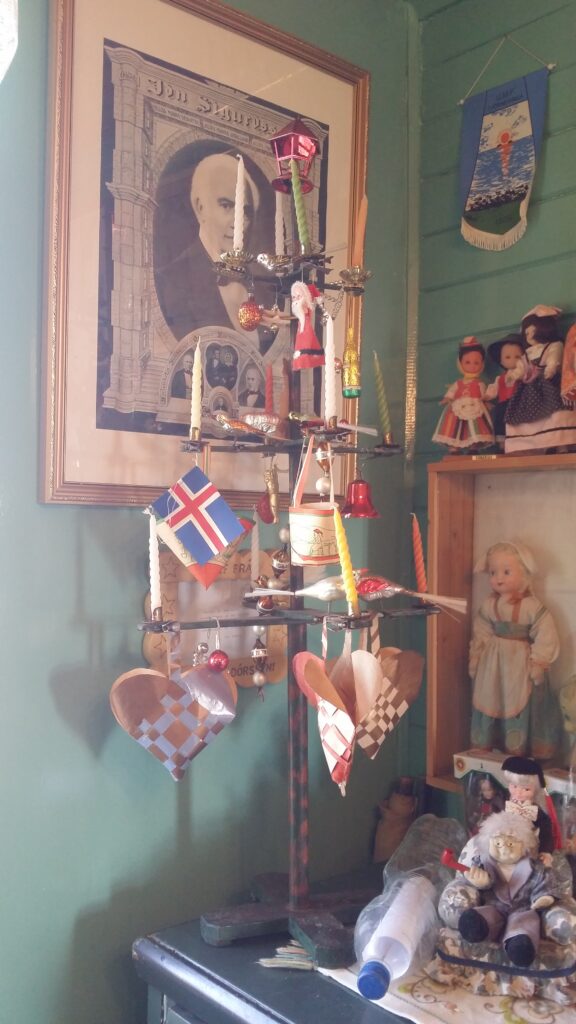
Iron Christmas tree at the Minjasafnið á Mánárbakka. When the forest is so completely missing that there are no available Christmas trees.
Memories of former forests linger in place names all over Iceland, for example there are an incredible number of “holts” consisting only of grassy meadows (“holt” is a clearance in a wood). Constantly cutting the largest trees transformed towering birch forests into degenerate shrubs, and grazing pressure from sheep prevented regrowth.
Vestfirðir. You take what you have – when you don’t have enough wood for fence posts.
The forest became particularly poor from the 16th century, when knitting began to gain momentum. This led to an explosive growth in the number of sheep, which grazed down all the new forest.
Erosion in practice at Patreksfjörður.
In the 20th century, large-scale reforestation began, planting 1-2 million trees per year. To allow the trees to grow in peace, they were fenced in.
Fencing is important. Vestfirðir.
Sheep, on the other hand, graze pretty much everywhere, albeit in somewhat more limited numbers than before, around 365,000 (2025) compared to previously 1 million!
Mývatn. The landscape changes slightly after reforestation.
After the car trip around the (Skaga)fjord, a bath is a good idea, to reminisce about the birch forests of before.
Eroded mountainsides in Skagafjörður.
The cozy little town of Sauđárkrókur has several good restaurants and also a splendid bakery. And bathing can be done the simplest way – in the backyard of Hótel Tindastóll!
Around 1220, an unstable and violent period began in Iceland called the Age of the Sturlungs, after one of the most powerful families, the Sturlungs, who had their power base on the west side of Skagafjörður. The balance between the wealthy families had shifted so that a few families had almost all the power. Sturlunga Saga, largely written by Sturla Þórðarson (nephew of Snorri Sturlason), deals with many of the events, and unlike older sagas, they were written almost in real time.
Map showing the klans, from ‘1238 Battle of Iceland Museum’ in Sauðárkrókur.
Murder, lying, mutilation and castration did not only take place between clans, there were sometimes a very bad atmosphere within families as well. Snorri Sturluson, for example, experienced that two of his sons-in-law: Kolbein young Arnórsson (Ásbyrning, from the east side of Skagafjörður) and Gissur Thorvalsson (Haukadælur), joined forces against the Sturlungs in the Battle of Örlygsstaðir in 1238, while Snorri himself was in Norway.
In addition to the replicas on display and lots of information, you can take part in the battle yourself – virtually. It was fun! The museum shop was also good.
The Battle of Örlygsstaðir was the largest ever fought in Iceland, where 1300 Sturlungs fought against the Ásbyrning’s and Haukadøl’s, a total of 1700 fighting men. The Sturlungs were attacked early in the morning and could do little since they were unprepared. Sturla Sighvatsson gathered a small flock and took shelter at Örlygsstaðir. This place is not quite the center of the world, not then and not now. It is described in the Sturlunga Saga as a sheep pen (Ref Heimskringla.no):
‘Then they all shouted and went up to the enclosure called Örlygsstaðir. There was a sheep pen there, but the fence was so low that you couldn’t barricade yourself at all.’
Rural atmosphere at Örlygsstaðir. No ‘city’ this is.
‘Sturla defended himself quickly and well with the spear called Gråside – it was a large brand spear that was old and not properly hardened. He struck so hard with it that people fell from the blow, but the spear blade was bent, and he straightened it several times under his foot.’
The Sturlungs lost the battle and lost many men, including the leader Sturla Sighvatsson, his father (Snorri Sturlasson’s brother) Sighvat Sturlasson (it’s super easy to keep track of names and order here…) and three of his brothers.
‘Then Gissur came and swept off his shields and also his steel helmet. He said: “I have something to do here.” He took a broad axe out of the hand of Thord Valdeson and hit Sturla in the head on the left side behind the ear. It was a large, but not very open wound.’
This battle was not the last, there was later a naval battle and a battle at Haugsnes as well, before Iceland in 1262 surrendered to the Norwegian king – in the hope that he would be able to end the civil war. And the family feuds? Gissur’s son and the saga writer Sturla Þórðarson’s daughter married in 1253, but the farm was set on fire and burned down during the wedding (Flugumýribrannen). The one they wanted to hit first and foremost was Gissur. However, he survived by hiding in a barrel, but his wife and 3 of his sons, including the groom, died. Gissur was later appointed by the Norwegian king to become the first earl of Iceland.
Reconstructed two-layered wool dress from the 13th century. Could be suitable for a wedding?
The Sturlunga era will never be forgotten on Iceland. When the Icelanders used their isolation from Denmark during World War II to free themselves (June 17th, 1944), these words were uttered:
Sameinaðir stöndum vér! Sundraðir föllum vér!
United we stand! Divided we fall!
Knut is looking for a waterfall to swim in.
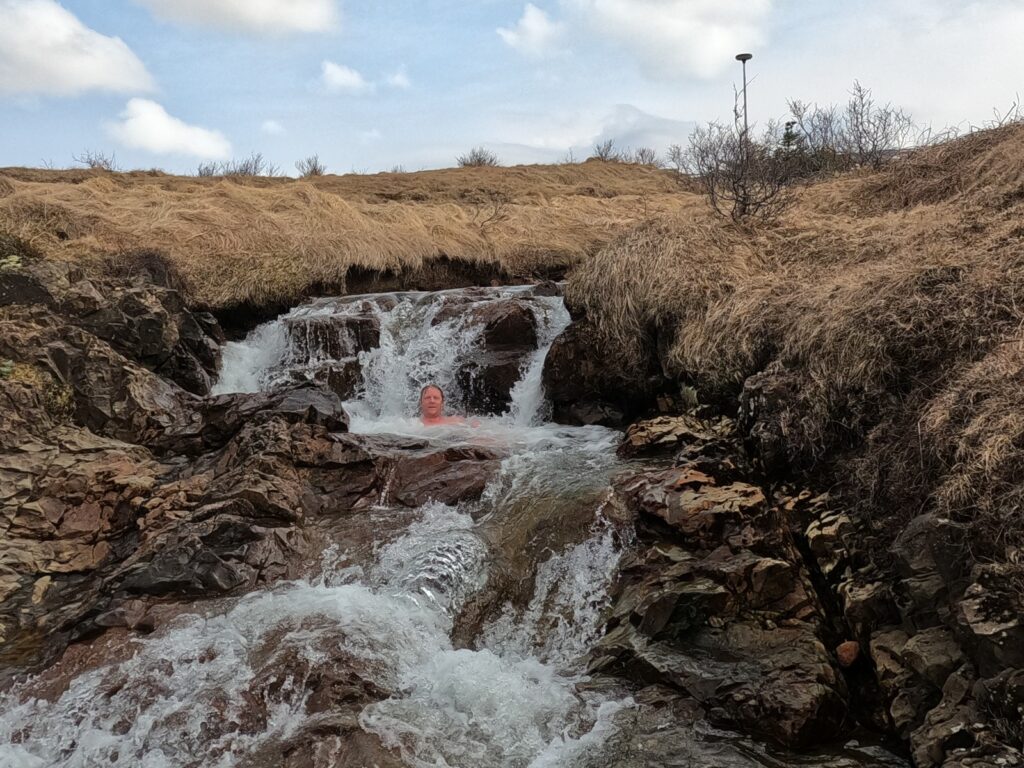
After fighting some tough virtual battles, a swim would be just right. Not far from Örlygsstaðir, a small river named Kotá flows west towards the Ring Road. If you follow the river upstream, you will come to a waterfall that you can walk behind. We like that!
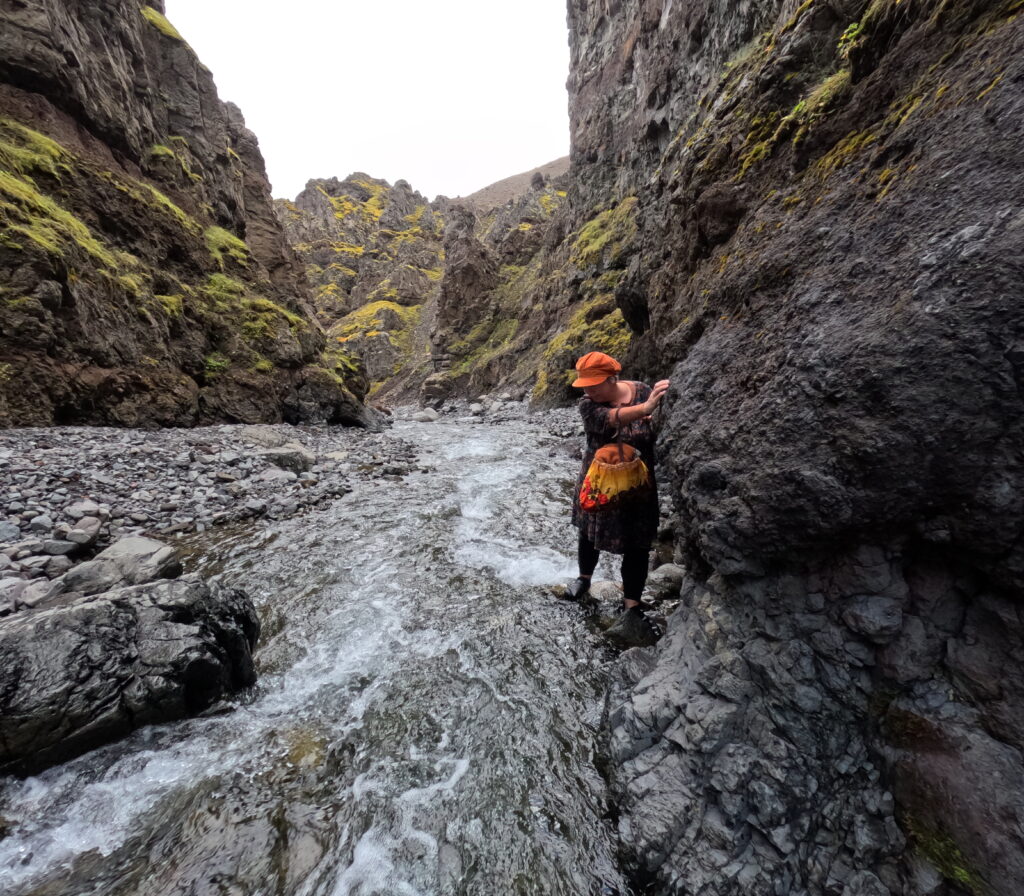
Kotá has excavated a nice gully eastwards from the ring road, south of Skagafjörður.
The creek was nice, but a bit tricky to walk in.
Hold on to your purse!
Idun was in bad shape that day and left Knut to do the swimming alone. Really.
Showering naked before bathing is a strict rule on Iceland. And Knut always follows rules…A little shallow, but still nice.
About a mile from Varmahlíð is Viking Raftingsenter, which offers different types of rafting, some more family-friendly and some more extreme. We did a family trip (because the extreme version was closed for the season) – and it was great fun!
Ready as an (2) egg!
There were 6 of us in the boat. The two of us plus three Icelandic girls and the guide. The trip went through a fantastic canyon with a couple of stops along the way. At one stop we were encouraged to jump into the river from a cliff. Everyone did, and we made it to shore one by one, although a couple of the girls struggled a bit and almost drifted away in the strong current.
70°C in the water spurce to the left, and 10°C in the river behind.
The highlight, however, was the cocoa break. We paddled to a small beach, walked a few meters along the riverbank and there was a hot spring. The water from the source was crystal clear and completely free of sulfur smell. The guide had brought cups and instant cocoa powder, added spring water with a temperature of 70 degrees, and voila, the hot drink was ready.
Good atmosphere during the cocoa break.
Towards the end of the trip we were given another challenge: ‘Those who want to, can jump into the river and let themselves be carried away outside the raft.’ Within 20 seconds, everyone had jumped in, and the guide was left a little bewildered: ‘I’ve never experienced this before, that everyone just jumps into the river right away!’.
Oooooh, this is so fun!
All in all, a great experience, which ended in the center’s hot pot. However, this was a tiny letdown. The water wasn’t exactly hot, and there were just 2 plastic tubs with hoses over the edge. In hindsight, we recommend going to Fosslaug Natural Hot Pot instead. But that’s a different story.
Hólar was the capital of Northern Iceland for centuries, and the second bishopric to be established in Iceland, in 1106. The Northlanders wanted their own bishop as a counterweight to the bishop of Skálholt. Both Skálholt and Hólar were under the Archbishopric of Nidaros (Trondheim/Norway) during the Catholic era. The bishop of Hólar was very rich, and at the Reformation the bishopric owned a quarter of all the lands in the north. The last Catholic bishop was Jón Arasón, who was taken to Skálholt and executed there along with his two sons in 1550. Celibacy was obviously not very important in Iceland – but the Reformation was indeed!
Hólar. The timber house to the left is a copy of a typical bishop’s office à la 1315 – made of timber from Norway.
After all this history, a bath will be just right, and this time it has to be the old-fashioned kind of a bath. Take road 752 south from Varmahlið, and you can experience a relatively unknown gem: Fosslaug.
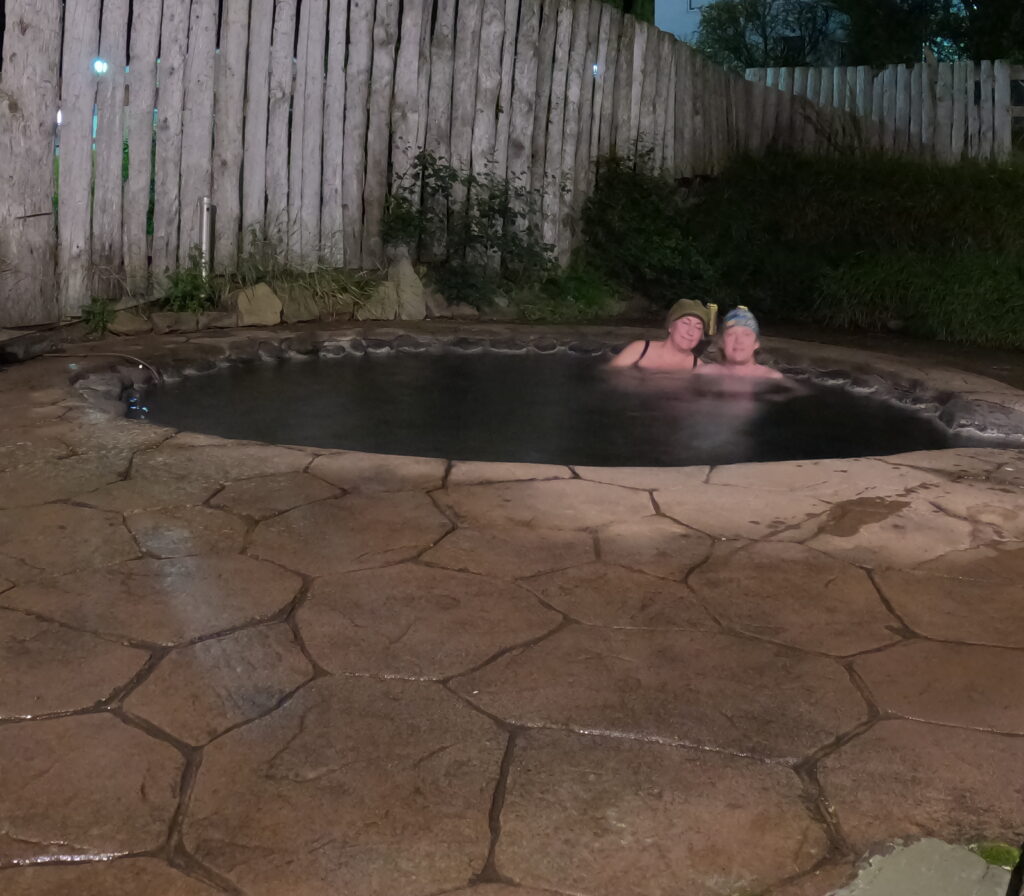
Bathing in Fosslaug.
You park next to the horse farm, greet the horses and follow the path to Reykjafoss. It is a beautiful waterfall with a large flow of water. The waterfall ends in a steep canyon, so swimming in the pool below the waterfall is difficult.
Reykjafoss.
On the upper side of the waterfall there is a hot spring. It’s boiling! From the rocks, hot water flows down into a stone-lined pool with space for 10 people. When the water slowly cools in the pool, it gets just the right temperature. AND – there are opportunities for cold water immersion in the river above the waterfall, all you have to do is lie down flat. A fabulous place!
Three levels of water: On the left, on top of the rocks – it’s boiling!. On the right, Fosslaug with just the perfect water temperature. Behind, cold water flows by on its way to Reykjafoss.