
Around 1220, an unstable and violent period began in Iceland called the Age of the Sturlungs, after one of the most powerful families, the Sturlungs, who had their power base on the west side of Skagafjörður. The balance between the wealthy families had shifted so that a few families had almost all the power. Sturlunga Saga, largely written by Sturla Þórðarson (nephew of Snorri Sturlason), deals with many of the events, and unlike older sagas, they were written almost in real time.

Murder, lying, mutilation and castration did not only take place between clans, there were sometimes a very bad atmosphere within families as well. Snorri Sturluson, for example, experienced that two of his sons-in-law: Kolbein young Arnórsson (Ásbyrning, from the east side of Skagafjörður) and Gissur Thorvalsson (Haukadælur), joined forces against the Sturlungs in the Battle of Örlygsstaðir in 1238, while Snorri himself was in Norway.

The Battle of Örlygsstaðir was the largest ever fought in Iceland, where 1300 Sturlungs fought against the Ásbyrning’s and Haukadøl’s, a total of 1700 fighting men. The Sturlungs were attacked early in the morning and could do little since they were unprepared. Sturla Sighvatsson gathered a small flock and took shelter at Örlygsstaðir. This place is not quite the center of the world, not then and not now. It is described in the Sturlunga Saga as a sheep pen (Ref Heimskringla.no):
‘Then they all shouted and went up to the enclosure called Örlygsstaðir. There was a sheep pen there, but the fence was so low that you couldn’t barricade yourself at all.’

‘Sturla defended himself quickly and well with the spear called Gråside – it was a large brand spear that was old and not properly hardened. He struck so hard with it that people fell from the blow, but the spear blade was bent, and he straightened it several times under his foot.’
The Sturlungs lost the battle and lost many men, including the leader Sturla Sighvatsson, his father (Snorri Sturlasson’s brother) Sighvat Sturlasson (it’s super easy to keep track of names and order here…) and three of his brothers.
‘Then Gissur came and swept off his shields and also his steel helmet. He said: “I have something to do here.” He took a broad axe out of the hand of Thord Valdeson and hit Sturla in the head on the left side behind the ear. It was a large, but not very open wound.’
This battle was not the last, there was later a naval battle and a battle at Haugsnes as well, before Iceland in 1262 surrendered to the Norwegian king – in the hope that he would be able to end the civil war. And the family feuds? Gissur’s son and the saga writer Sturla Þórðarson’s daughter married in 1253, but the farm was set on fire and burned down during the wedding (Flugumýribrannen). The one they wanted to hit first and foremost was Gissur. However, he survived by hiding in a barrel, but his wife and 3 of his sons, including the groom, died. Gissur was later appointed by the Norwegian king to become the first earl of Iceland.

The Sturlunga era will never be forgotten on Iceland. When the Icelanders used their isolation from Denmark during World War II to free themselves (June 17th, 1944), these words were uttered:
Sameinaðir stöndum vér!
Sundraðir föllum vér!
United we stand!
Divided we fall!

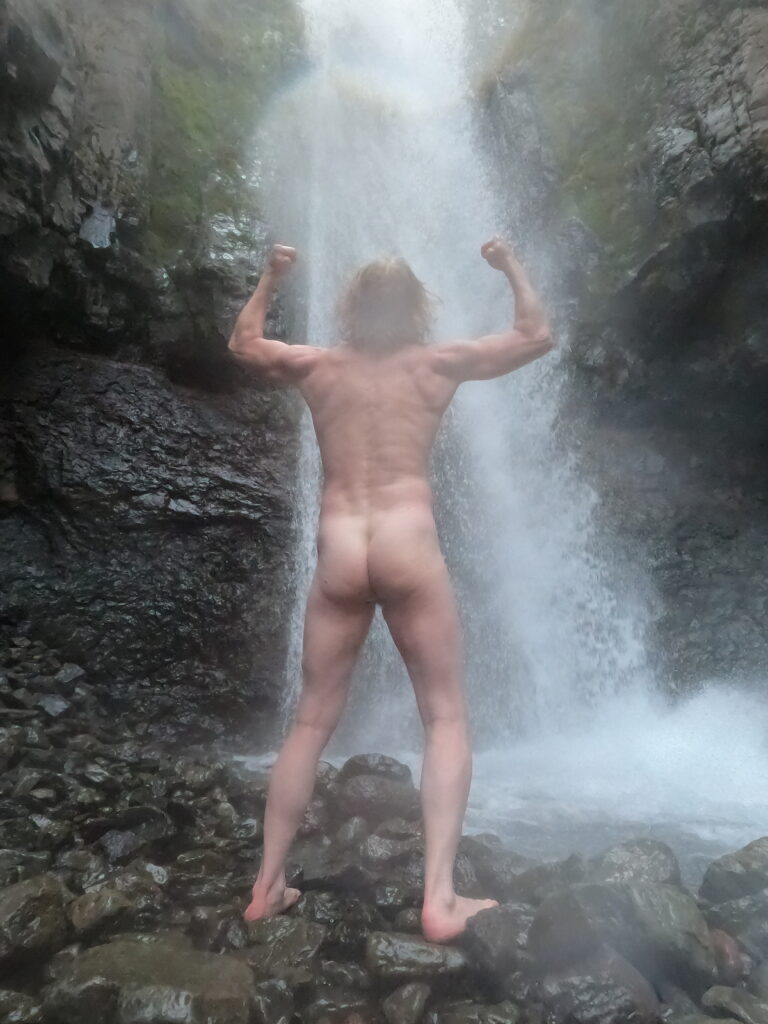
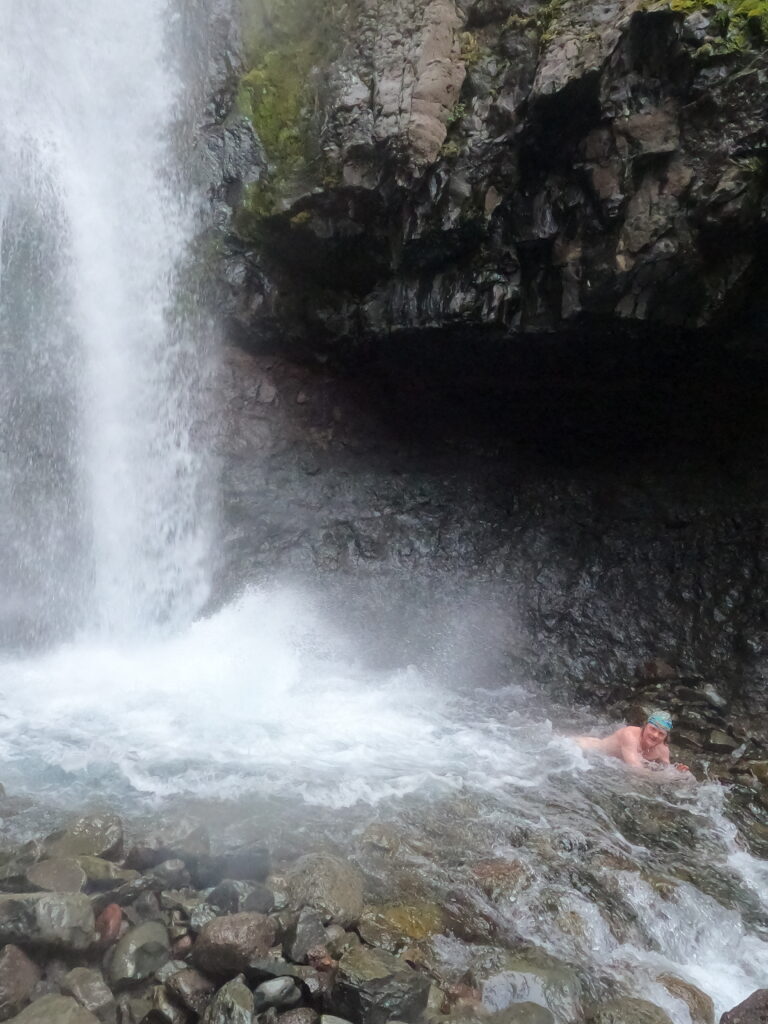
After fighting some tough virtual battles, a swim would be just right. Not far from Örlygsstaðir, a small river named Kotá flows west towards the Ring Road. If you follow the river upstream, you will come to a waterfall that you can walk behind. We like that!

The creek was nice, but a bit tricky to walk in.
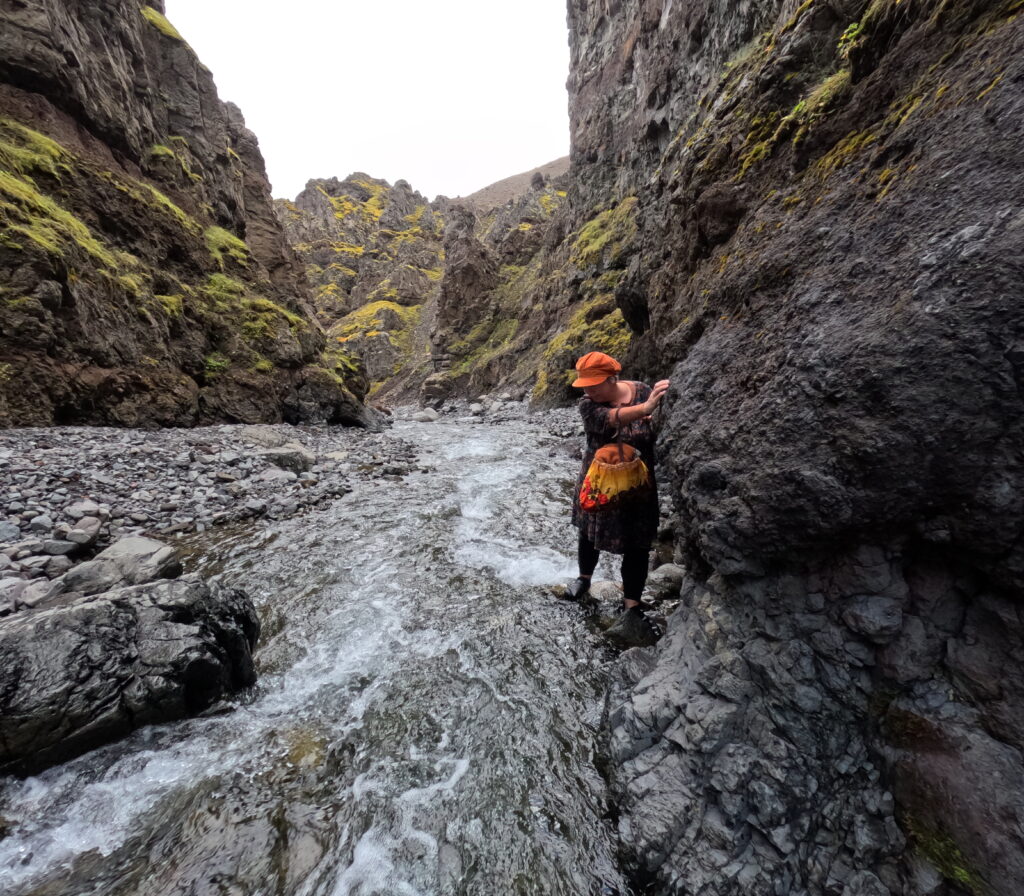
Idun was in bad shape that day and left Knut to do the swimming alone. Really.
Ref:
Heimskringla.no