Cape Kolka

On our way to Riga from Ventspils, we were faced with the obvious choice: Take the ‘straightest road’ through the middle of (Kur)land, or the somewhat smaller country road along the beautiful coast. We naturally chose the latter, it had to be splendid, right?
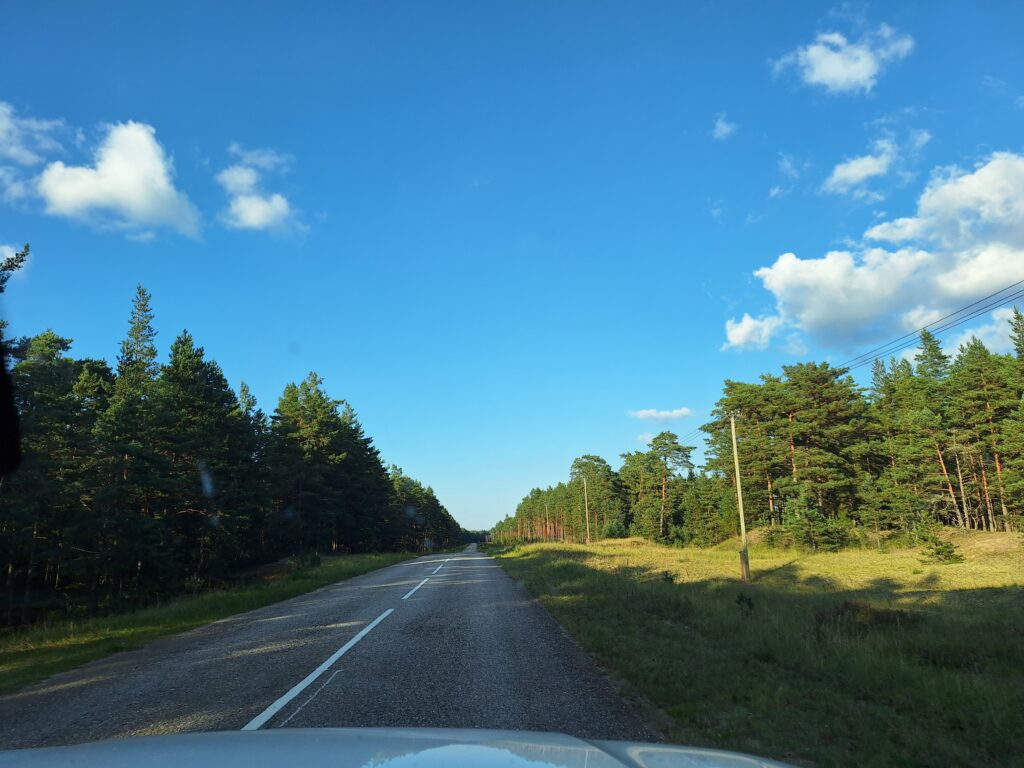
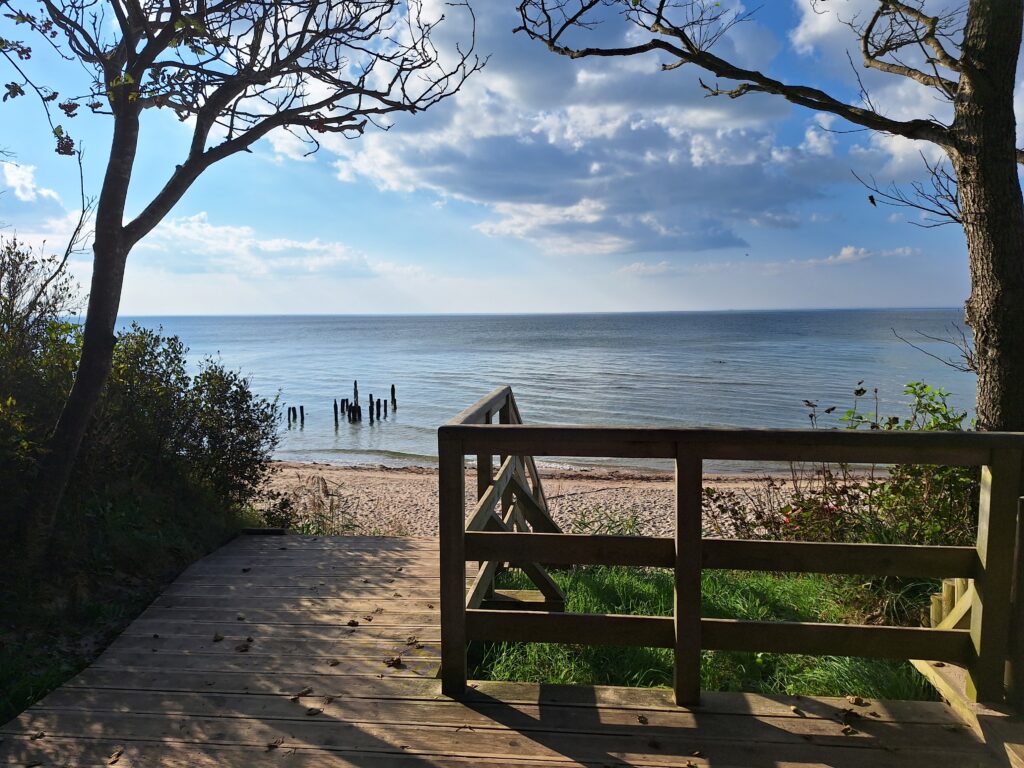
The view from the panoramic road along the sea. The forest was so dense and high that we only saw glimpses of the sea, when passing a river or a small settlement.

The population density northwards along the Kurzeme coast is very sparse, but in total there are (traces of) 12 villages along the 75 km long coastal strip that once was the last outpost of the Livonian language area.
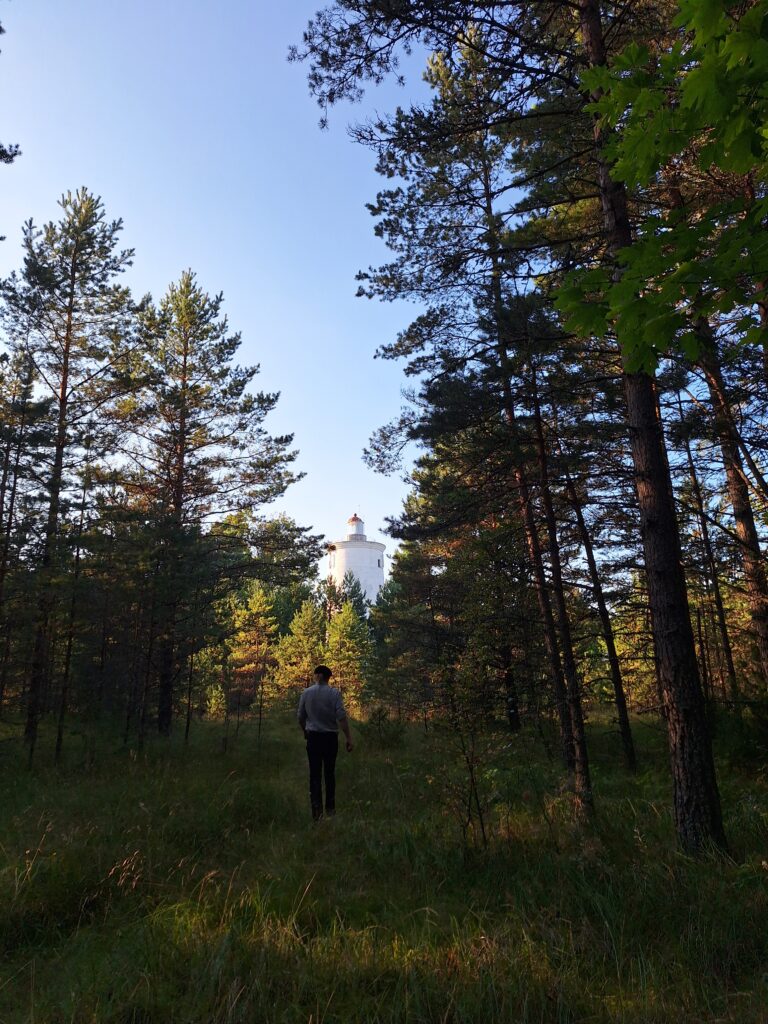
Ovišu bāka. In the middle of the pine forest, 350 meters from the sea, at the westernmost point of the Livonian coastline, if you search really hard, you will find Latvia’s oldest lighthouse, Ovišu bāka. When it was completed in 1814, the light was created by 20 oil lamps mounted on a mechanically rotating base.

Livonian is a Finno-Ugric language, related to Estonian. Latvian, on the other hand, is an Indo-European language and completely incomprehensible to Estonians and Livonians. The main area of ​​the former Livonia was on the north-east side of the Gulf of Riga, including south-western Estonia. There were two varieties of the language: East Livonian, which died out in the 19th century, and West Livonian, which has barely survived to this day, between Ventspils and Latvia’s North Cape (Cape Kolka/Kolkasrags).
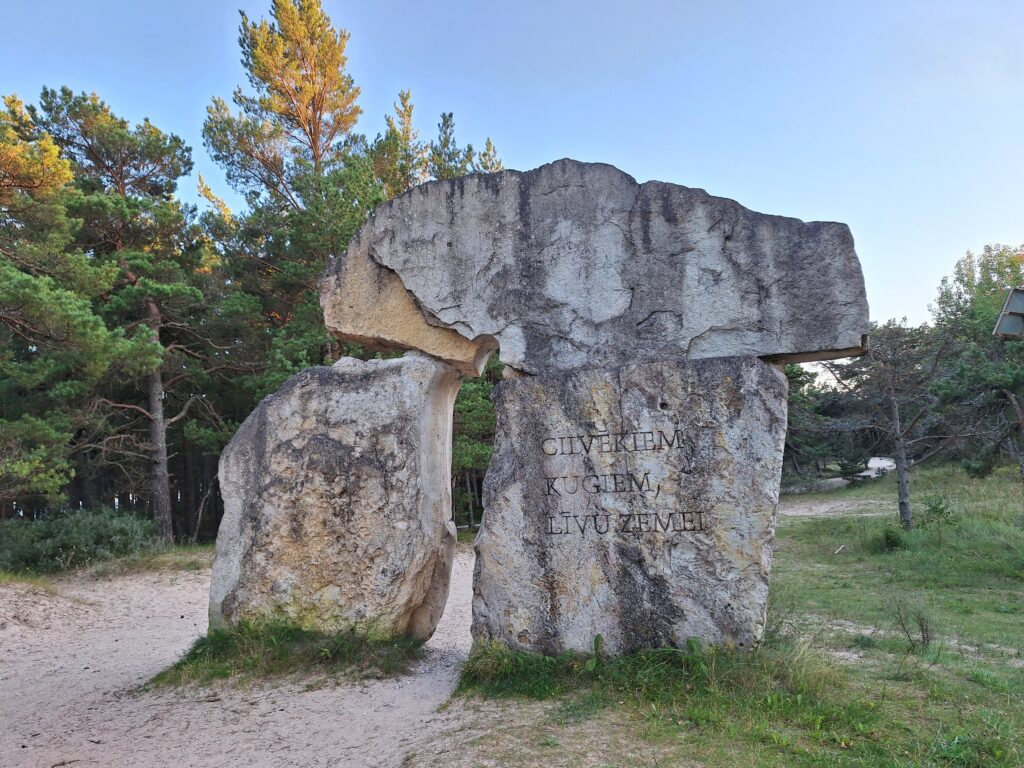
At the very end of Cape Kolka stands Ģirts Burvis’ beautiful sculpture “To Those Taken by the Sea” The monument is designed as a symbolic gate, with the Kolka Lighthouse visible through the human-like opening.

The area has been invaded with varying degrees of success by Vikings, Germans (Teutonic Knights), Swedes, Danes, Poles, French (Napoleon), Russians and Germans (Nazis). After World War II, the Soviet Union annexed all of Latvia, and the Livonians were forcibly removed from their villages. The Soviet Union wanted full control of the coast, and set up listening posts and border guards. Most of the Livonians moved away to Ventspils and Riga, and without access to the coast and their villages, they could not maintain their way of life based on fishing, logging and boat building, nor their language.
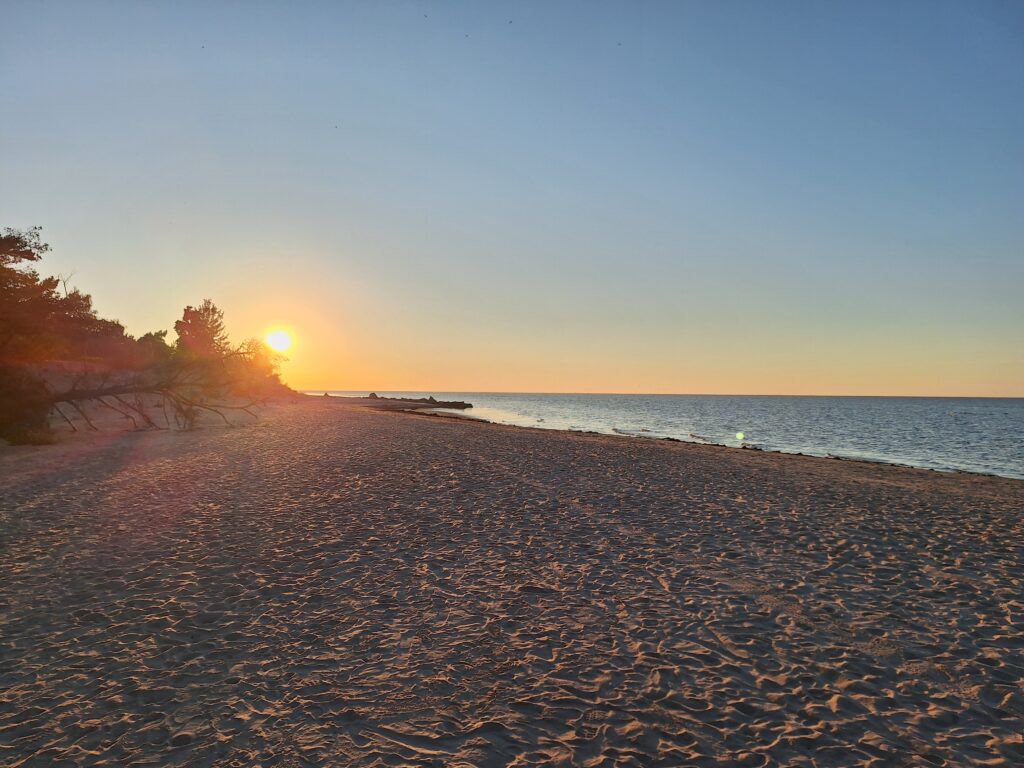
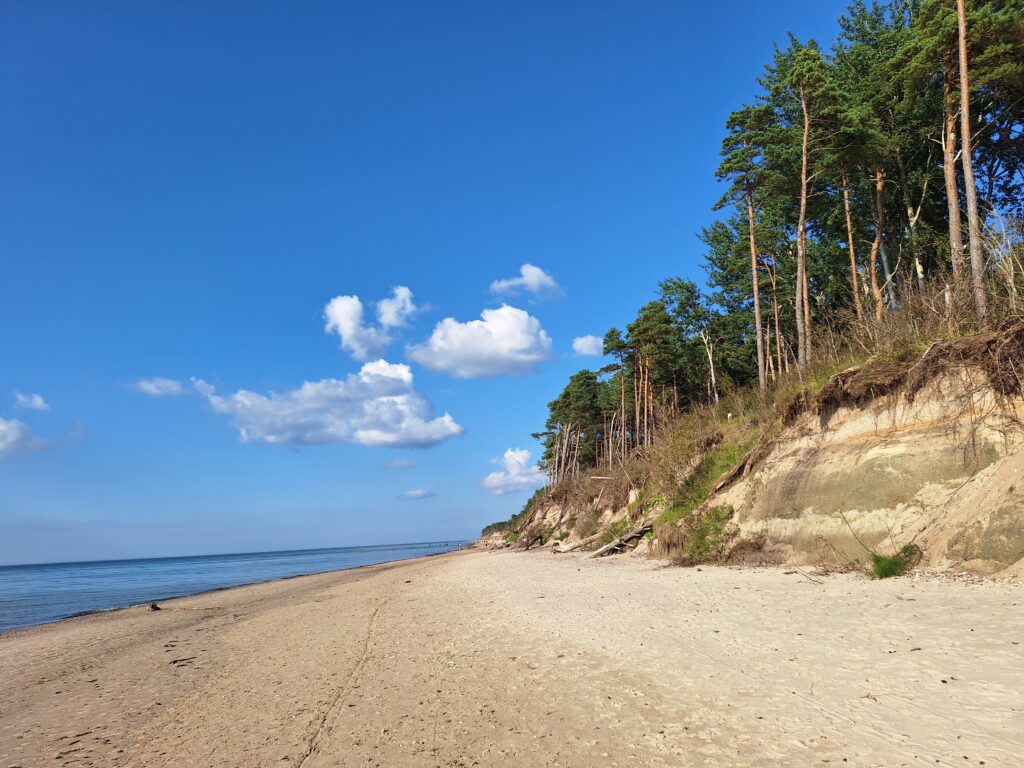
Sandy beaches as far as the eye can see on the Livonian coast.

Livonian language went extinct in 2013, when the last native speaker, Grizelda Kristina, died. ‘That was it!’ as the Norwegian comedian Fleksnes would have said. But no! The language has come back to life! Language advocates Renāte Medne and Jānis Mednis are raising their daughter Kuldi Medne (born in 2020) with Livonian as her only mother tongue (this is a bit reminiscent of how Eliezer Ben-Yehuda brought modern Hebrew to life). This appears to be a bit lonely, since they live in Helsinki. But an exciting project, for sure! On the other hand; Finnish is in the same language group, and when you look at the numbers, the difference from Finnish may not be so dramatic:

1 – ikš – Yksi
2 – kakš – Kaksi
3 – kuolm – Kolme
4 – nēļa – Neljä
5 – vīž – Viisi
6 – kūž – Kuusi
7 – seis – Seitsemän
8 – kōdõks – Kahdeksan
9 – īdõks – Yhdeksän
10 – kim – Kymmenen

And of course, you can always take your vacation on the Livonian coast and talk to older people who speak Livonian as a second language (the sample is about 40 people). But we can only hope that the daughter has the humor to bear the fact that she was raised as an experiment.
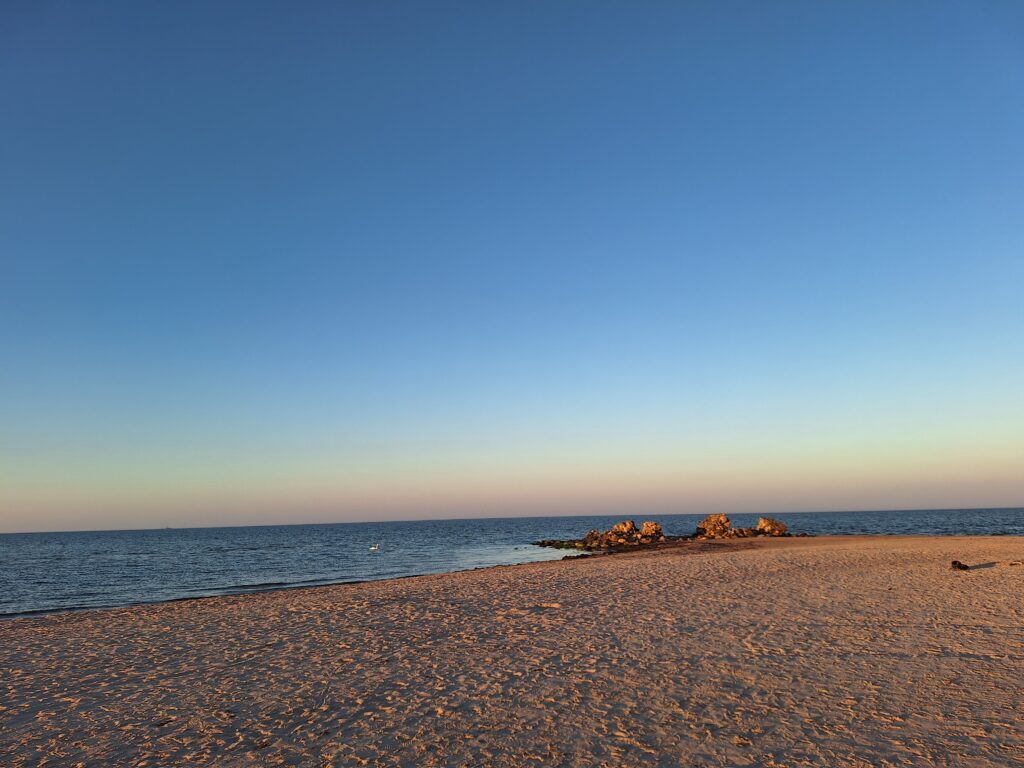
Kolkasrags, or ‘Domsnes‘ as the Vikings called it (ref Mervallastenen near Stockholm). We wanted to swim here! To the left of the swan, far far away, you can see the Kolkas bāka lighthouse, which is located on an artificial island built in 1872 of stones from the Estonian island of Saremaa. The ruins in the middle of the picture are the remains of the old lighthouse.

It turns out that the headland where the ‘Big Sea’ (the Baltic Sea) and the ‘Little Sea’ (the Gulf of Riga) meet is not suitable for swimming. Massive warnings! The sandbank extends several kilometers into the Baltic Sea (underwater), and the oncoming water masses create waves and whirlpools, which have sunk many ships throughout history. Unfortunately, this turned out as a ‘No-swimming’ bath! On the other hand – with a support boat, wetsuits and nice weather, it should be possible to take a swim here. Not that we know anyone with a boat around here. But it could be a fun project to swim out to Kolkas bāka. The lighthouse is 6 km from Kolkasrags and was completed in 1875 (at that time 5 km away – the erosion is working fast here).
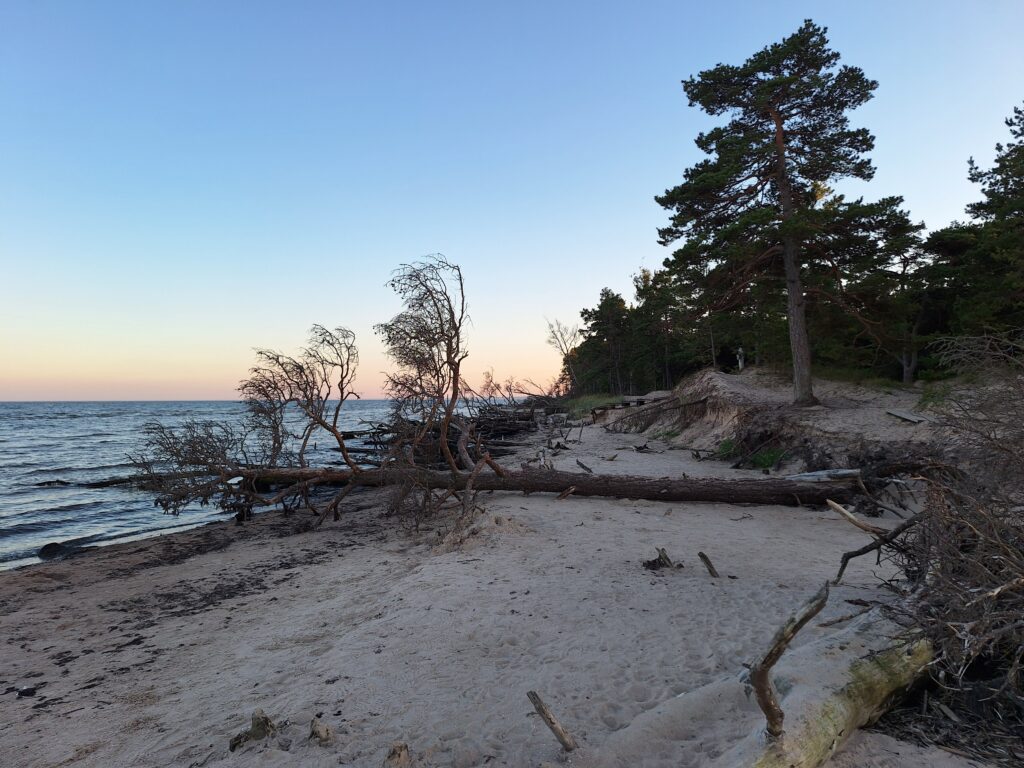
Erosion in practice at Kolkasrags.

As of now (2025), it was basically not right to bathe at Cape Kolka.

Then it’s time to say like the Livonians: Tienū! (Thank you!)
Ventspils

Tobatheornottobathe had broadbathed Europe’s widest waterfall; Ventas Rumba, and now we were heading west to the river mouth, where the Venta River meets the Baltic Sea. Venta has its source in Lithuania, it is 346 km long and just over half of its length runs through Latvia. The lower part is wide, almost stagnant and an excellent, ice-free harbor. In short, a perfect place to settle. The city on the estuary is called Ventspils and has 44,000 inhabitants today.

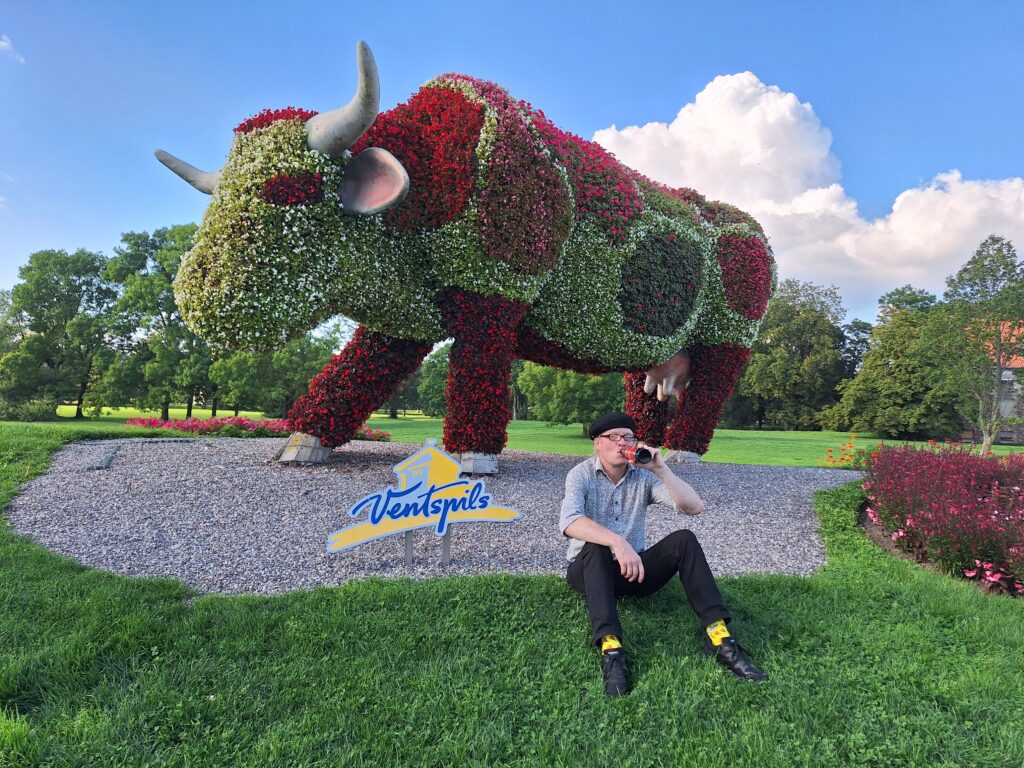
Knut has a ‘Wartenbier’ in Ventspils.

It was a funny name, you might think (Waitbeer), but it makes perfect sense. Pils means castle or town, and Ventspils is therefore the town by the river Venta. No time to wait here! Under Russian rule, the port was expanded and the town became a busy hub. Transport of Russian minerals and oil has made Ventspils Latvia’s richest town – even richer than Riga. (Tobatheornottobathe doesn’t know if oil exports from Russia are still going on – does anyone know?)

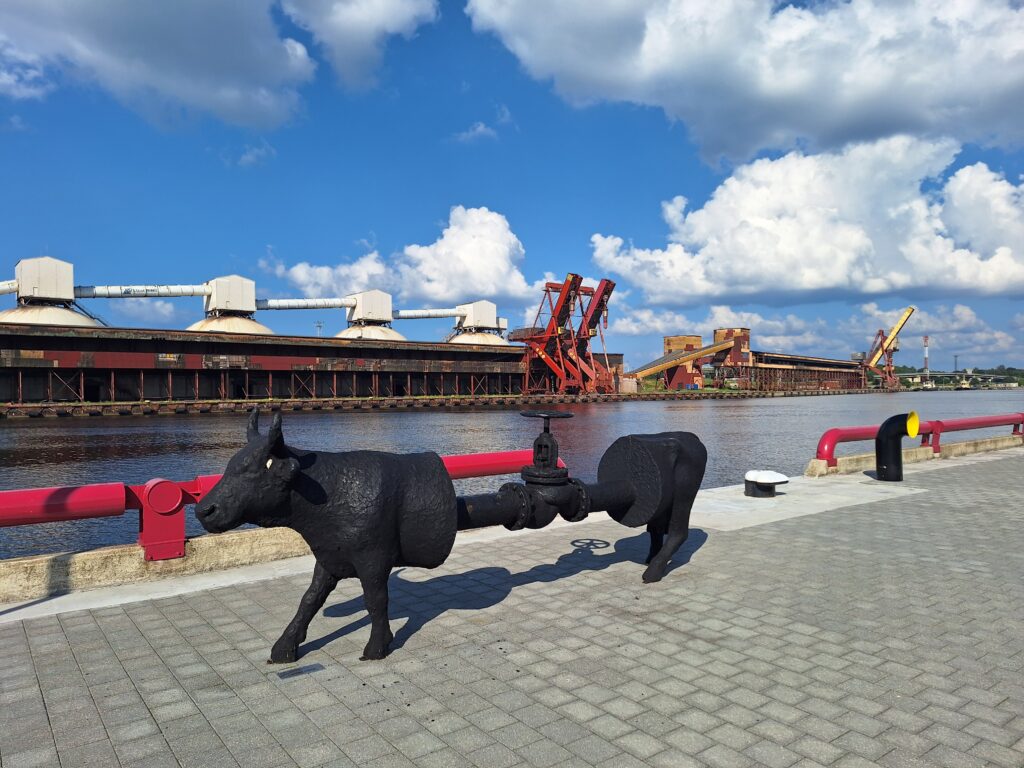
The industrial port is located on the right bank of the Venta river. Impressive things!

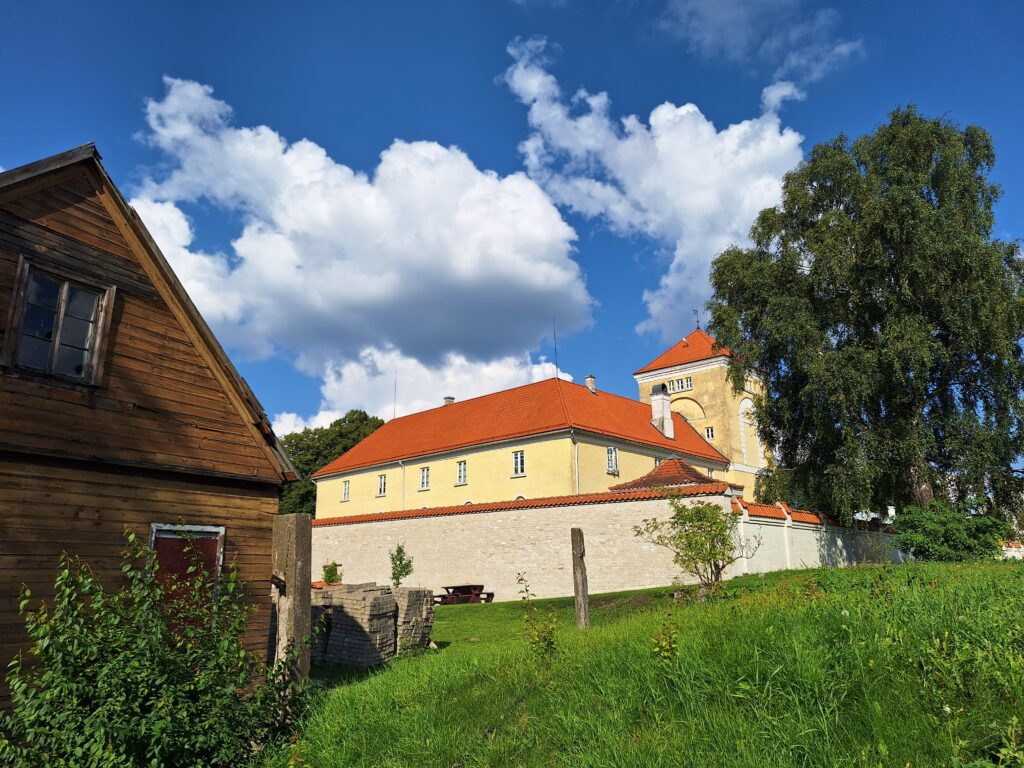
The river promenade on the left bank is nicely arranged with benches and works of art. Here you will also find the castle of the Livonian Order, a branch of the Teutonic Order, with origins dating back to the Crusader era. When the activity in the Middle East waned, forced missionary work began in the Baltics in the 13th century instead. Ventspils received city status in 1378, and was one of Latvia’s Hanseatic cities. In German, the city was called Wandau.

The castle of the Livonian Order in Ventspils is now a museum.

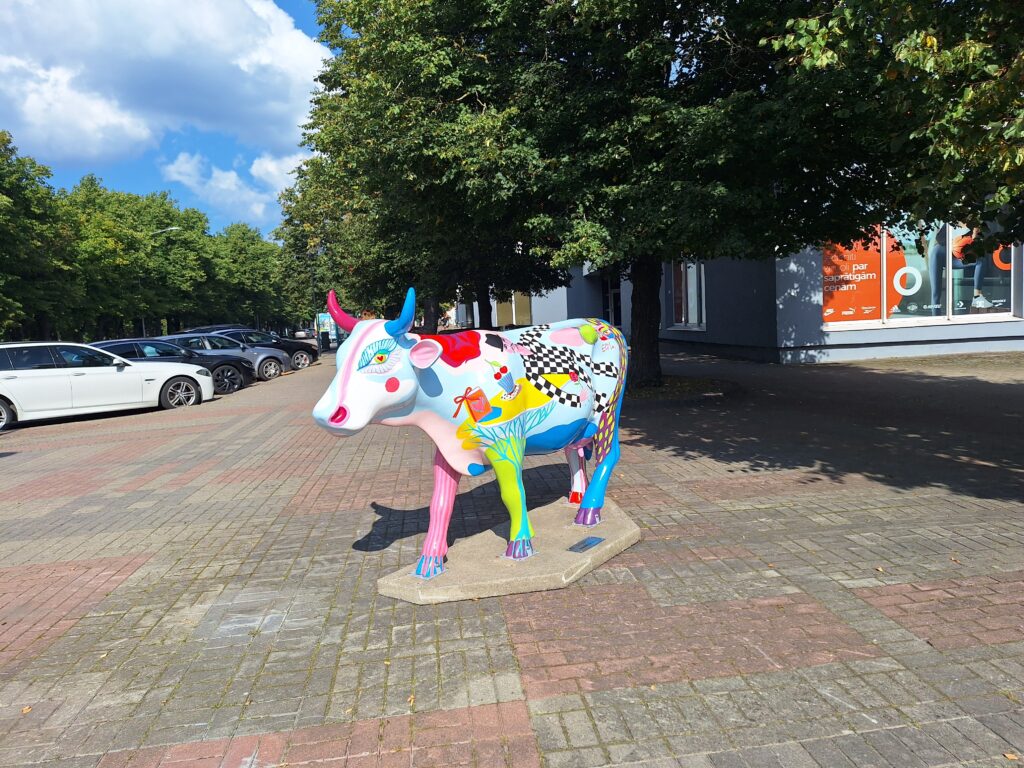
Ventspils has a pleasant old town with a varied architectural style. Watch out for cows! In the international art project “Ventspils Cow Parade 2002“, elaborately decorated cow statues were placed around the city. They have become very popular, and 24 cow statues still exist. Another art project was the creation of a separate, Ventic, currency: Ventu. The banknotes offer discounts on various cultural and recreational experiences. We didn’t get any Venti during our short visit to the city. Next time! The banknotes feature images of various city cows.

Artistic cow in Ventspils.

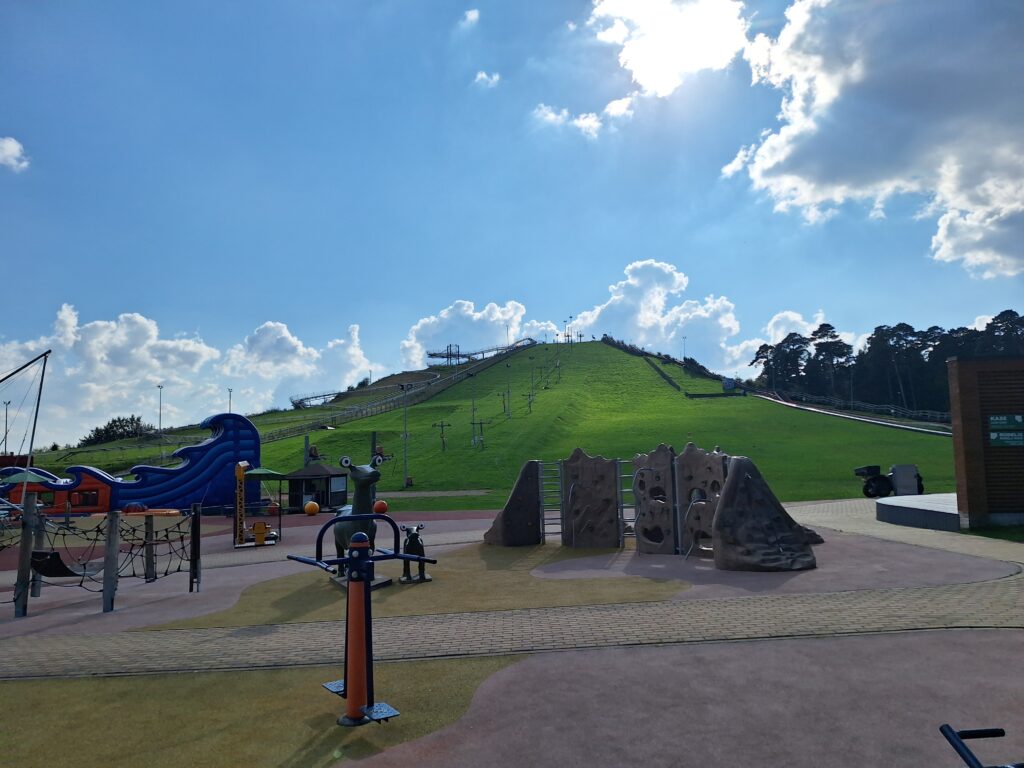
Ventspils has plenty of sandy beaches both north and south of the city. Among other leisure activities, we would like to try bobsleigh, or possibly slalom. Yes, you read that right. In the flat, flat ‘Flatvia’ there is actually a hill with a ski lift and a bobsleigh track near Ventspils. Who would have thought that?

In the absence of both mountains and hills, an artificial mountain has been built near Ventspils (yes, the hills in Latvia are called mountains).

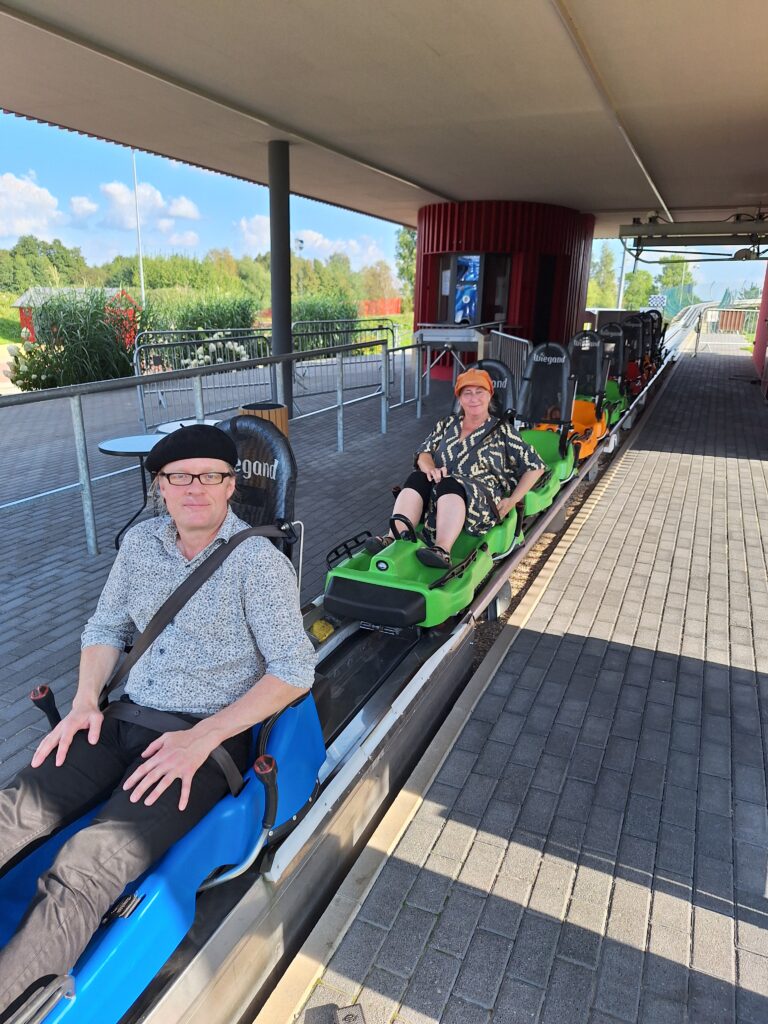
On the mountain ‘Lemberga Hūte’ = Lemberg’s hut (after Aivars Lembergs, a very controversial politician condemned for corruption), you can ride a bobsleigh – also in summer time. The instructions before departure were very simple: ‘No camera. Use the brake if you get scared. Don’t stop!’ It was fun, oh yes! And Knut didn’t use the brake.

Tobatheornottobathe is ready for Bobsleigh (2025). The rest of the park was open, and we can recommend it for families. Varied and good offers.

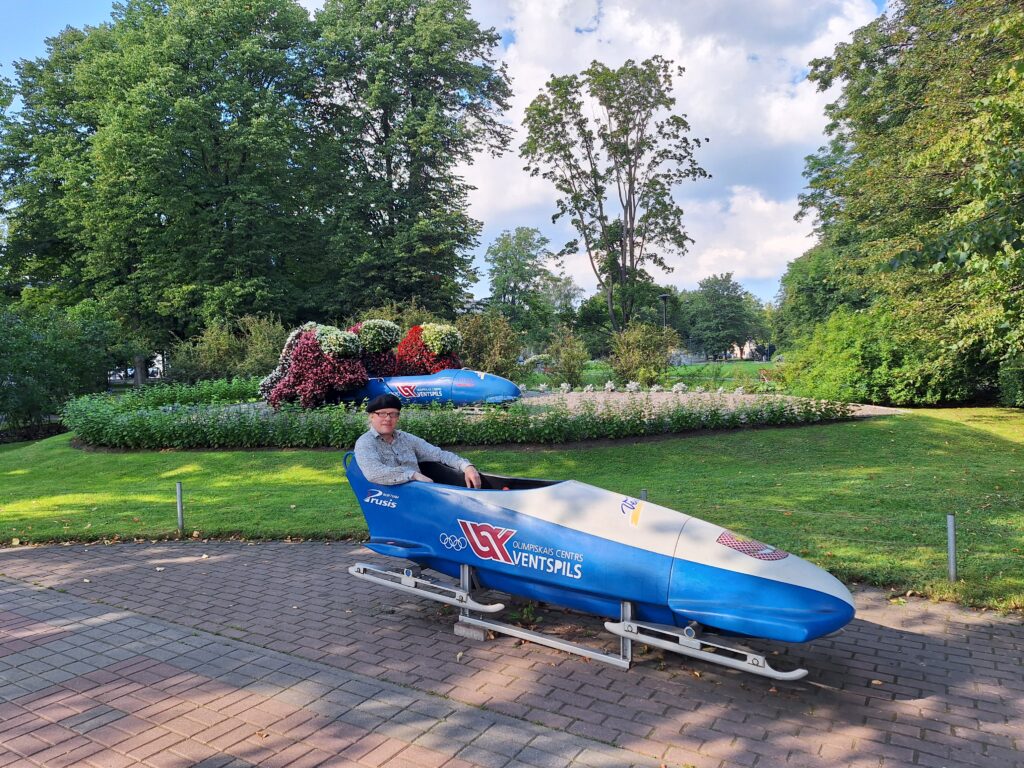
Ventspils has honored its bobsleigh champion Gatis Gūts (not world champion, no!) with a monument in the city. Flower bob monument – we haven’t seen that before! The sled was donated by a local bobsleigher, Sandis Prūsis, in 2004. 400 flowers are used in the sculpture.

Knut test-drives the sled, but there was disappointingly little speed.

After this little digression, it was finally time for our favorite activity: bathing. We chose the beaches on the north side of town, because we had seen winter photos of a small waterfall that looked sooo nice.

Staldzenes stāvkrasts. We found no waterfall, and concluded that it has no water in the fall.

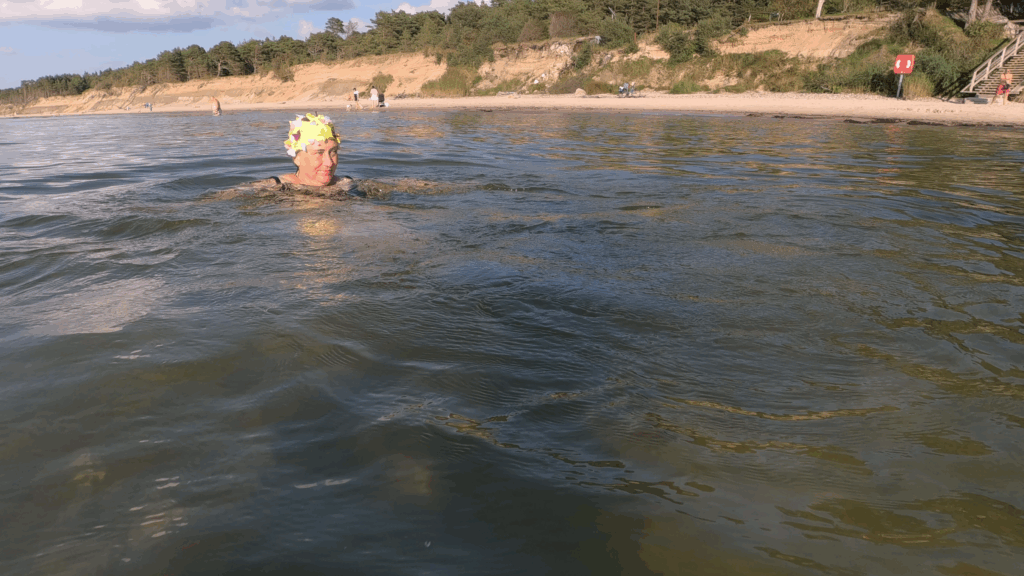
Staldzenes stāvkrasts, also called the cliffs of Latvia (!), consists of sand dunes 4-18 meters high. Erosion is ongoing here, easily visible in the form of fallen trees. This is a very nice place to both bathe and swim. Not particularly crowded either – in September.

Yep, a swimming trip to Venstpils is just right!

How wide have you bathed?

155 km west of Riga lies the beautiful little town of Kuldīga. So beautiful that it has been inscribed in the UNESCO World Heritage List. The town was founded by the Venta River and was the capital of the Courland region (today Kurzeme), in the western part of Latvia.

Venta with Kuldīga on its left bank. In the background the spires of the churches of St. Catherine (the city’s patron saint), and St. Anna. The bridge from 1874 is 164 meters long.

Kuldīga is mentioned in written sources as early as 1242, and became a Hanseatic city in 1368 under the name Goldingen. The Curonian duces had a castle here, which no longer exists. However, the town has a charmingly variety of architecture: wooden houses, brick houses, half-timbered houses, and so on, with many different styles.

Pedestrian street Liepājas iela. The facade is important, as can be seen in the wooden house on the right.

Kurzeme was annexed by Russia in 1795, and had a flourishing period in the 19th century with industrial development. Today, tourism is important, not least domestic tourism.

The Town Hall Square in Kuldīga was formerly the city’s marketplace.

The small river Alekšupīte flows through the old town of Kuldīga, before ending in the Venta river just below town. Could it be used for bathing? That was something Tobatheornottobathe wondered about.

The Alekšupīte (River Aleks) literally flows through the city.

Yes. We found a waterfall in Alekšupīte. Latvia’s highest waterfall in fact! With a brick dam on top. But no, that water was so muddy and green that we didn’t want to swim there at all.

Latvia’s highest waterfall – 4.15 meters high and 8 meters wide!

The importance of measuring the width of a waterfall is not something we have thought about before. But it makes sense – when you live in a country that is completely flat. Then suddenly the width becomes more important than the height.

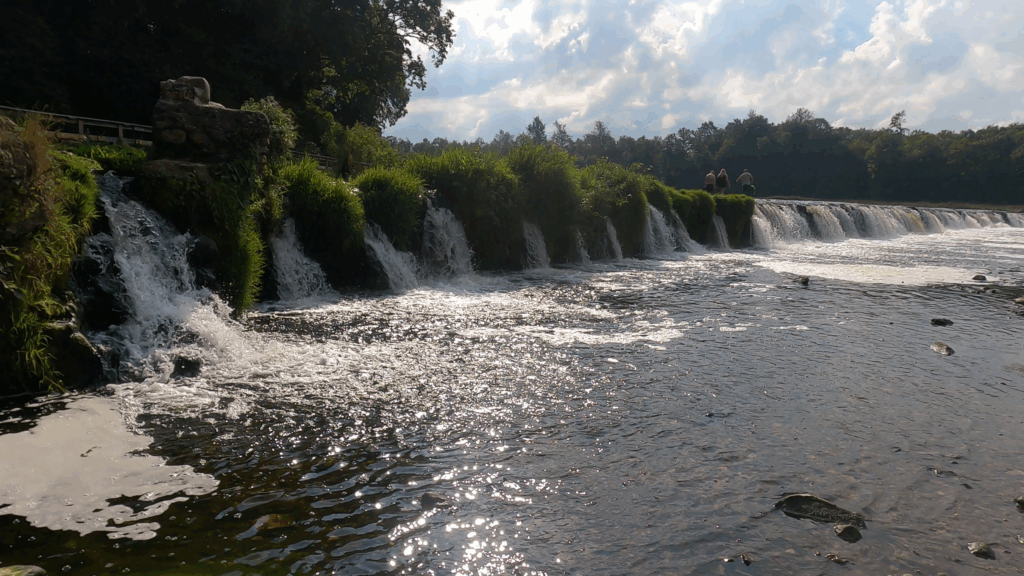
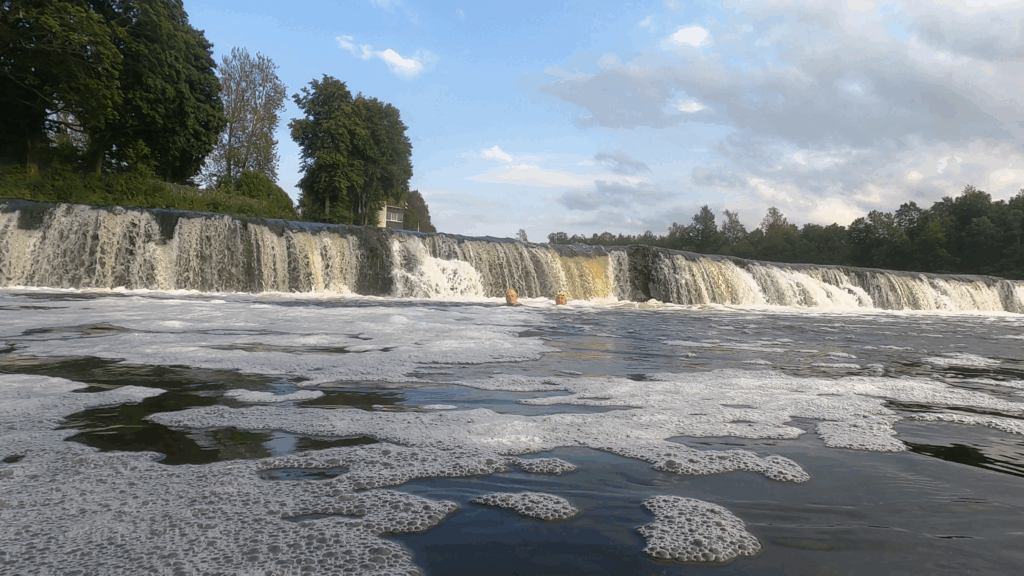
(F)Latvia has Europe’s widest waterfall: Ventas Rumba.

The width of the waterfall varies with the amount of water. Ventas Rumba is usually about 249 meters wide, but it can reach up to 275 meters during floods. We visited Kuldīga in September and unfortunately did not see any jumping fish. In October, fish go up to spawn, and jump up the waterfall, which led to the development of self-fishing in Venta.

Fishing luck in Ventas Rumba. Just mount a basket and the fish will jump in by themselves. Photo: Kuldīgas novada muzeja krājums – KNM 2632Ø

We were excited! We weren’t alone either, there were several people who wanted to have a free massage in river Venta. The official (safer) swimming area is located above the waterfall, well-equipped with floating docks.

Log art by the bathing area.

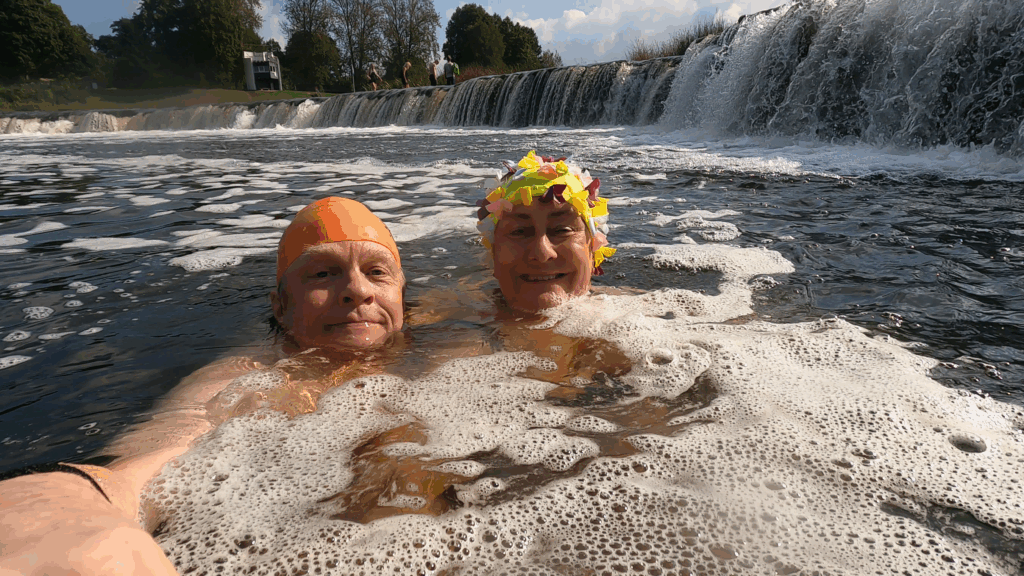
Tobatheornottobathe prefer to swim in the waterfall itself, and luckily there were no prohibition signs there, just a simple warning: ‘It can be dangerous to swim in the waterfall. All bathing at your own risk.’ Keep it simple!

The first part of the waterfall is most reminiscent of Hraunfossar in Iceland, but in the middle there is much more speed. The pool is correspondingly deep, and we saw several people jumping and doing somersaults down the waterfall.

When the waterfall is a couple of hundred meters long, it’s easy to laugh at the height of only 2 meters, but this water also hits the body hard and gives a quite good massage.

Enough about that. Or? While we were getting dressed, Idun came up with the funny question in the title, from Kurt Olsson’s interview with high jumper Patrik Sjöberg: ‘How wide have you jumped?‘ Suddenly things got serious, because we couldn’t answer the question without having done it: To swim wide. Next morning we went back to the waterfall to swim wide. Idun was a little nervous, she didn’t want any rescue operation in case we got swept away by the current. But the river flattens out quickly below the waterfall, so it shouldn’t be that dangerous.

Tobatheornottobathe does a wide bath in Venta.

It went really well! We swam as close to the waterfall as possible, drifting just a little off in the strongest current. And the answer to the question? Our widest swim took place after a couple of days of rain, and was about 249 meters long.

After a long swim, you need to replenish your energy, and there are many options in Kuldīga. And if the evening is still young, we can mention that they are good with saunas in Latvia. Very good!

‘What’s that naked statue doing on that rooftop?‘, we wondered. In Kuldīga they’re not afraid of nudity. The receptionist at the hotel could tell us that at Midsummer there’s a naked race across the bridge. We wonder if Knut has to come back here!